
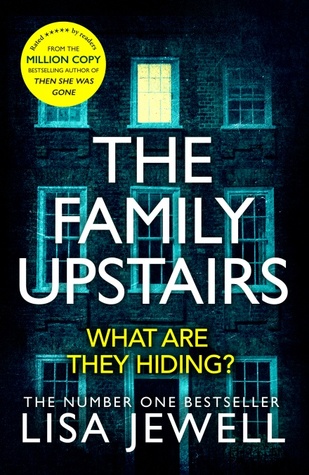
Pages: 446
Published: 6th August 2019
Genre: Mystery/Thriller
Content warnings: Drugs, rape/sexual abuse

Soon after her twenty-fifth birthday, Libby Jones returns home from work to find the letter she’s been waiting for her entire life. She rips it open with one driving thought: I am finally going to know who I am.
She soon learns not only the identity of her birth parents, but also that she is the sole inheritor of their abandoned mansion on the banks of the Thames in London’s fashionable Chelsea neighborhood, worth millions. Everything in Libby’s life is about to change. But what she can’t possibly know is that others have been waiting for this day as well—and she is on a collision course to meet them.
Twenty-five years ago, police were called to 16 Cheyne Walk with reports of a baby crying. When they arrived, they found a healthy ten-month-old happily cooing in her crib in the bedroom. Downstairs in the kitchen lay three dead bodies, all dressed in black, next to a hastily scrawled note. And the four other children reported to live at Cheyne Walk were gone.

This was a dark and complex tale which kept me fully invested throughout. With timelines spanning both past and present; and told from the contrasting perspectives of three characters who were inextricably connected yet living very different lives, the story became more engrossing with each page.
The plot was extremely well crafted and brought with it an element of mystery and tension, along with an atmosphere that felt increasingly sinister. There are also several unexpected and perfectly timed twists that change the complexion of the story and leave you questioning what happened right up until the very end.
The book opens on Libby’s 25th birthday, where she is amazed to discover that she has been left a large and expensive house in Chelsea from a trust fund set up by her birth parents. Along with another man, her parents had died in an apparent suicide pact when she was a baby, and the house has stood empty ever since. She soon enlists the help of a journalist to uncover what led to those events.
Meanwhile, Lucy is in France and living in poverty while trying to provide for her two children and their dog. She is desperate for a place to stay and to obtain the means to return to England, and is forced to resort to extreme measures, asking for financial support from her abusive ex-husband Michael.
The final POV is that of Henry, who lived in the house in Chelsea at the time of the deaths when he was a teenage boy. Told in the first person, Henry recounts the eerie goings on, which over the space of five years saw his family life descend into misery and depravity at the hands of the mysterious people who came to stay.
The book mostly alternates between the three storylines, and the link between them soon becomes clear. The question then is, how did the past lead to the present? The sequence of events is slowly unravelled in a way that leaves you determined to know more. It is a plot full of mystery, and I loved how it kept me guessing about the fate of each character.
All of the storylines brought a different feel and had their own unique atmosphere. It was intriguing to follow Libby as she went in search of information about her family’s past, and I also thought that reflected the reader’s need to know more. Lucy’s extreme poverty comes across very acutely in the writing, while the past timeline with Henry is the darkest and most interesting of all.
Whenever a book uses this technique, the storylines ultimately converge and here it is done to very good effect. There are a couple of dramatic twists, and the odd moment that makes you stop and think about everything that has happened. For that reason, I was a little surprised at how neatly it was all resolved by the end.
My favourite character in the book was Libby. Although I did not enjoy the constant hints towards a romance with Miller, I found her very likeable and easy to connect with. I shared her unquenchable desire to find out what happened, and related to several of her personality traits. I did not connect quite as much to Lucy, but in the context of the book her actions did not seem out of place.
As a narrator, Henry is as unreliable as they come. There are many different sides to his character and right up until the end it leaves you unsure as to whether he is good or bad, or simply damaged by the things that happen around him. I thought the enigmatic way he was written was truly magnificent.
The other characters all brought a lot to the story. Henry’s parents and their reaction to what was happening around them was particularly eye-opening. David and Birdie were mysterious yet exceptionally evil, while Phineas was another complex character who was explored in impressive detail.
One of Lisa Jewell’s biggest strengths is that she is able to write plot-driven books while still placing a huge emphasis on character development, and that is very evident here. This story is gripping and moves along at a steady pace, but the way the characters were written helped to make it even more immersive.
The house made for a creepy and claustrophobic setting. The way it was described felt quite Gothic, and the unsettling atmosphere that prevailed brought Henry’s isolation from the outside world to the surface. Using a setting like this is a familiar concept, but here it is done to very good effect.
Overall, the combination of a menacing tone and a compelling plot made this a difficult book to put down. I was fascinated to find out what each chapter had in store and a twist never seemed far away. The characters were all well realised and some were wonderfully complex, putting the seal on a riveting read.

A dark and fabulous mystery that makes great use of multiple POVs and has several good twists. My sixth book by Lisa Jewell, and definitely one of my favourites.
My rating: ⭐⭐⭐⭐

 Stephen Reads Books