
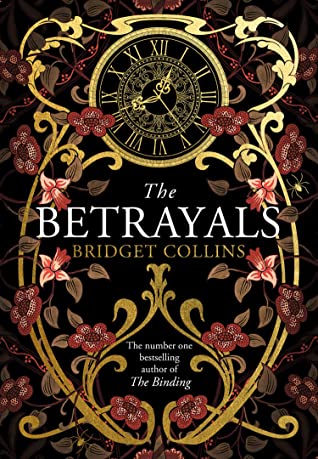
Pages: 425
Published: 30th November 2020
Genre: Fantasy/Dystopia
Content warnings: Misogyny, strong sexual references, suicide references, bullying
This was a buddy read with Pauliina. We both had an interesting time with the book and had mixed feelings, but it gave us so much to talk and speculate about. I really enjoyed our discussions, so thank you Pauliina for reading it with me! Check out her brilliant review.

At Montverre, an exclusive academy tucked away in the mountains, the best and brightest are trained for excellence in the grand jeu: an arcane and mysterious contest. Léo Martin was once a student there, but lost his passion for the grand jeu following a violent tragedy. Now he returns in disgrace, exiled to his old place of learning with his political career in tatters.
Montverre has changed since he studied there, even allowing a woman, Claire Dryden, to serve in the grand jeu’s highest office of Magister Ludi. When Léo first sees Claire he senses an odd connection with her, though he’s sure they have never met before.
Both Léo and Claire have built their lives on lies. And as the legendary Midsummer Game, the climax of the year, draws closer, secrets are whispering in the walls…

This book is the literary equivalent of abstract expressionism, for it provides such a unique concept that ranges from the brilliant to the bizarre depending on which way you look at it. Told from a quartet of contrasting perspectives and revolving around complex character dynamics that occur across separate timelines, it is fascinating and compellingly written but also suffers from a severe lack of development in certain key areas.
The unconventional nature of the novel is such that it is very difficult to place it in a particular genre, and the outcome is something of a mix. Fantasy would perhaps be the most obvious candidate due to the setting, but there is more than a hint of dystopia to go with the elements of romance and even historical fiction. What is for sure is that it is endlessly thought-provoking.
Montverre is an institution where male scholars study the grand jeu, a mystical game influenced by music and mathematics among other things. Leo Martin was one of the brightest ever students to attend, but everything changed for him after a tragic incident. Now, after an abrupt and damaging end to his political career, he has been sent back to reacquaint himself with the grand jeu.
Back at a place which holds so many contrasting memories, he arrives in a somewhat disordered state and soon meets Claire Dryden, the first woman to ever hold Montverre’s most prestigious post of Magister Ludi. He immediately feels a strange connection to her, despite being convinced that they have never met before.
With the legendary Midsummer Game approaching, Claire is determined to prove herself as Magister Ludi and defy the many who feel she is unsuitable for the role. However, she is also perturbed by Leo’s presence and unknown to him, she is reading the diary which he kept while he was a scholar. In the process, she uncovers some of his deepest held secrets.
The storytelling is highly immersive but at the same time rather intangible, which gave much of the book a permanent sense of mystery. It seemed like an occasion where you would just have to read on in order for the entire premise to become clear, but in the end not everything does and I was left wanting to know more. This is most epitomised by the concept of the grand jeu, which is very central to the plot yet never fully explained.
A lot of imagination goes into creating the narrative, but the world building is desperately lacking. It takes place during an unspecified time period within an alternative reality where women are marginalised, and there are also hints towards political tensions and religious divisions. These sub-plots are always present in the background, but they are not properly addressed or explored in enough depth.
Indeed, it almost feels like the chief purpose of the world is to act as an unusual backdrop to events surrounding Leo and Claire, which were the most interesting part of the story. The connection they have towards each other is difficult to understand at first, but then comes a really surprising twist much later on which changes everything and creates an extra layer of tension.
Of the four different perspectives, two of them focus on Leo and span both the present timeline and the diary entries he wrote while he was a scholar, with the latter told in the first person. The diary entries are especially insightful and well written, but neither cast him in a very positive light. His self-importance and occasional misogynistic remarks make him quite an unlikeable character.
Claire was my favourite character and I enjoyed reading her chapters the most. It was like living among her many insecurities and conflicting thoughts, and it is only until late on in the book where you realise the full extent of her complexity. Her story is very bittersweet and it always feels like she is battling against the odds, but the writing gives her a powerful aura and she is easy to root for.
The fourth and most unusual perspective of them all is the Rat, a woman whose identity is not revealed until the end. These chapters give very little away and are told metaphorically, which keeps you guessing as to where it fits in relation to the rest of the story and also the timeline in which it takes place.
Along with the world building, the other main disappointment is the lack of development given to most of the supporting characters. Emile becomes extremely important late on but before then he is only mentioned in passing, while Charpentier’s role in the book is totally ambiguous. The only exception is Carfax, who is right at the very centre of the plot during Leo’s diary entries and I really connected with him.
There is a real sense of atmosphere about Montverre, which has the grand feel of a classical place of study yet also contains a slight hint of underlying menace that becomes more noticeable in the Rat’s chapters. As for the writing style, it is eloquent and at times flowery, and together with the uniqueness of the story it really helped to transport me into its pages.
The ending was a bit of a mixed bag. After the massive plot twist takes place it gets very gripping as the story turns on its head, but then once some of the questions are answered and we discover the true nature of certain characters, the outcome is that the world stays the same despite everything that has happened. As a result, it was not as impactful as I had hoped.
Overall, this is a book like no other in many ways. It is adorned with bewitching prose and varying perspectives that are written with an incredible amount of thought and precision, though often it felt like the author was only telling half the story. There is a lot to admire but it leaves behind a degree of frustration, as with more world building and character development it could have been outstanding.

For a lot of the book I was not quite sure what to make of it. Having reached the end, I can conclude that while there are definitely problems with it, I enjoyed it enough not to give it too low a rating. Mysterious and intriguing, but also a little frustrating.
My rating: ⭐⭐⭐

 Stephen Reads Books