Pages: 340
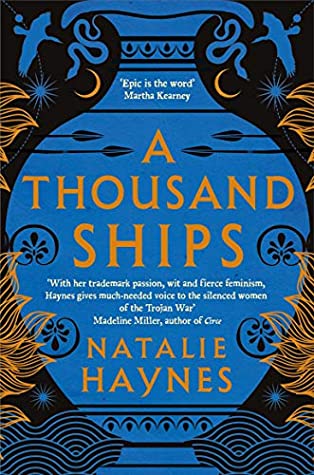
Published: 2nd May 2019
Genre: Mythological Fiction
Content warnings: Allusions to sexual exploitation, rape, misogyny, injury detail
This was never the story of one woman, or two. It was the story of all of them…
In the middle of the night, Creusa wakes to find her beloved Troy engulfed in flames. Ten seemingly endless years of brutal conflict between the Greeks and the Trojans are over, and the Greeks are victorious. Over the next few hours, the only life she has ever known will turn to ash…
The devastating consequences of the fall of Troy stretch from Mount Olympus to Mount Ida, from the citadel of Troy to the distant Greek islands, and across oceans and sky in between. These are the stories of the women embroiled in that legendary war and its terrible aftermath, as well as the feud and the fatal decisions that started it all…

One of great travesties of history and indeed mythology is that invariably the voices of women have been either forgotten or wilfully ignored, but we are now in a somewhat happier era in which they are being reclaimed by an impressive class of modern storytellers. This is one stellar example of these rather gorgeous retellings, and it takes place on as grand a scale as you could possibly imagine.
It takes the epic tale of the Trojan War and weaves a story of not just some of the women who are associated with it, but literally all of them. The outcome is something intricately detailed and richly immersive, as the tables are turned on the established narrative and the spotlight is instead cast on characters who in spite of their hitherto lack of recognition turn out to be just as compelling.
The feminism aspect is unquestionably there and this book sets the record straight and then some, with a whole multitude of perspectives comprising of the women of Greece, Troy, and also Mount Olympus. Of course, the chief male protagonists in the Iliad such as Achilles, Agamemnon, and the forever mercurial Odysseus all have a role to play, but for once this story does not belong to them.
There is a list of characters at the beginning that acts as a very useful point of reference, and then it begins with Calliope, the Muse of epic poetry. A poet asks her to sing, and that gives way to chapters which are devoted to all of the women, almost all told in the third person. Just about every one of them is interesting and well imagined, bringing their fair share of tragedy as well as themes of loss and revenge.
Possibly my favourite perspective is that of Penelope, written in the form of letters to her husband Odysseus and latterly the goddess Athena. These chapters are clever and witty, giving Penelope a really vivid personality as she outlines her many virtues but also a growing impatience at Odysseus’ failure to return home to his kingdom of Ithaca after many years at sea.
The other main group of recurring characters are the Trojan women, namely those who are the most inextricably connected to the story of the war and have now been rendered powerless by the victorious Greeks. These chapters consist of a large amount of dialogue and is essentially one long conversation between them as they prepare to learn their fates. It is this alone that gives their story an impact.
Hecabe is formidable even at a time where she has lost everything, and her sharp tongue is a memorable feature of the book. Polyxena is the more measured of the group while the understated yet spirited Andromache at least gets a relatively positive ending. As for Cassandra, what happens to her is quite sad and this is explored in a powerful way.
She is not the only one whose pain is severely pronounced. We have Creusa, stranded in the ruins of Troy. Iphigenia, victim of a human sacrifice by her own father who seeks to appease the gods. And Laodamia, unable to cope with the grief following her husband’s death. The author communicates these sub-plots with great artistry and sensitivity, made all the more pronounced by the fact that their essence has rarely been captured before in literary terms.
But do not fear, this book does not tell solely of heartbreak and bloodshed, for some of the characters royally entertain with their unique personalities. One of the highlights was Themis, whose discussion with Zeus about plotting the war is rather amusing, and a standout example of how the mythology is made more accessible for the reader. Then we have the single-minded determination of Oenone, and also the lengthy yet strangely mesmerising scene where Paris has to decide who should receive the coveted golden apple.
Calliope’s chapters are short and sweet, each of them barely lasting more than a page but at the same time providing a symbolic reflection of the plot. Indeed, she is essentially the narrator and beyond that, it is as if the author is speaking through her to reinforce the point about the forgotten women about whom she writes. This is admirable, although I did not like the rather self-congratulatory way in which it came across.
Otherwise, the writing is impeccable for the most part; well researched and with a meticulous attention to detail. On the face of it the sheer number of characters and perspectives threatens to be overwhelming, but instead it works extremely well even if I might have preferred a slightly more chronological approach. It is lyrical, engaging, and entirely captivating.
Overall, this book sets its stall out to achieve something and it succeeds with flying colours. Unique and full of fascinating characters who each have their own story to tell, it is an exciting and varied read from start to finish. What truly sets it apart however is the concept, which is smartly executed and offers an alternative picture of a story many of us thought we knew, making it a retelling that is stylish in the extreme.
Along with being an author, Natalie Haynes is a broadcaster, journalist, and comedian, working extensively on BBC radio. Among this body of work is Natalie Haynes Stands Up For The Classics, a show which sees her make all kinds of interesting remarks about historical figures from ancient Greece and Rome.
A Thousand Ships was nominated for the Women’s Prize for Fiction in 2019 and is her most noted book to date. Having also written Amber Fury and The Children Of Jocasta, her latest novel Pandora’s Jar was released in 2020.
A hugely impressive, ground-breaking book with fascinating perspectives almost everywhere you look. I really enjoyed it.
My rating: ⭐⭐⭐⭐

 Stephen Reads Books