Hello everyone,
I have recently read two non-fiction books, and today I am sharing my thoughts on them in the form of miniature reviews. It is the first time I have really done this on my blog, but I felt that in this particular case it was most suitable just to give a quick overview rather than anything too long-winded.
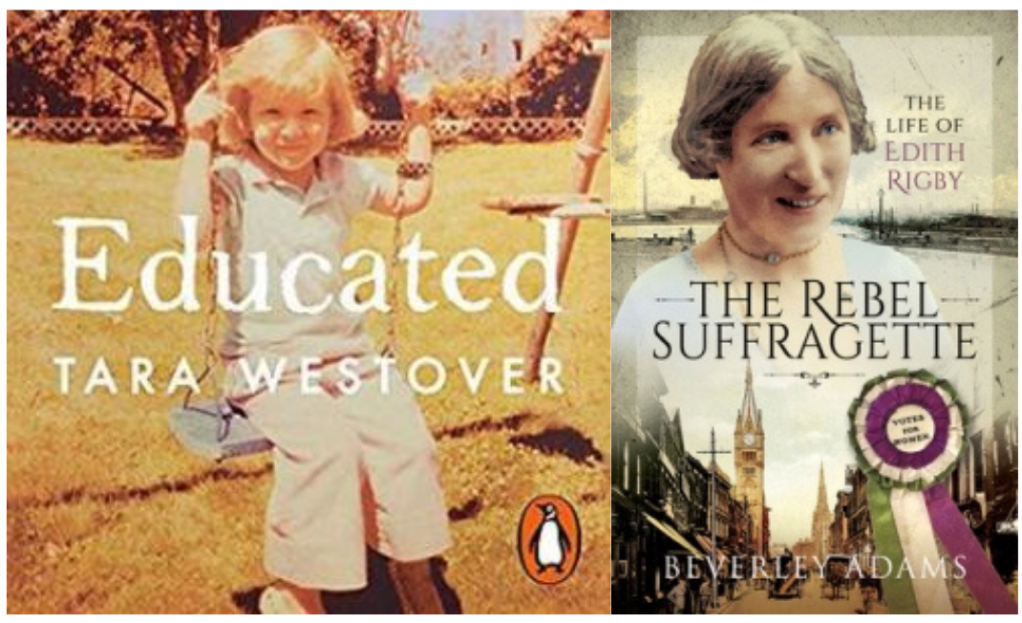
Educated by Tara Westover has received a lot of attention and acclaim, for the remarkable tale it relays about a woman with no birth certificate who after growing up in an extreme survivalist household, went on to complete a PhD. I listened to the audiobook and was often taken aback by the story.
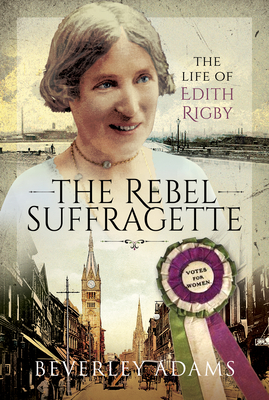
Meanwhile, The Rebel Suffragette by Beverley Adams recounts the life of Edith Rigby, an important figure in the campaign to secure votes for women in the UK in the early 20th century. I received a free complimentary copy from the publisher and felt excited to read a book written by someone who I connected with on book Twitter.
On with the reviews!
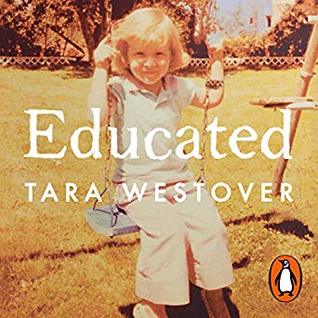
Narrator: Julia Whelan
Published: 20th February 2018
Genre: Memoir
Content warnings: Misogyny, descriptions of violence, racism
Tara Westover was seventeen the first time she set foot in a classroom. Born to survivalists in the mountains of Idaho, she prepared for the end of the world by stockpiling home-canned peaches and sleeping with her “head-for-the-hills” bag. In the summer she stewed herbs for her mother, a midwife and healer, and in the winter she salvaged metal in her father’s junkyard.
Her father distrusted the medical establishment, so Tara never saw a doctor or nurse. Gashes and concussions, even burns from explosions, were all treated at home with herbalism. The family was so isolated from mainstream society that there was no one to ensure the children received an education, and no one to intervene when an older brother became violent. When another brother got himself into college and came back with news of the world beyond the mountain, Tara decided to try a new kind of life.
She taught herself enough mathematics, grammar, and science to take the ACT and was admitted to Brigham Young University. There, she studied psychology, politics, philosophy, and history, learning for the first time about pivotal world events like the Holocaust and the Civil Rights Movement. Her quest for knowledge transformed her.

In many ways, this book comes across like a novel and it certainly contains descriptions of things that you would not expect to be true, but the truth is exactly the opposite. The extraordinary facts of Tara Westover’s life are as shocking as they are uniquely told, as we learn of her most unlikely journey from beyond the bounds of civilisation to collecting the highest academic achievements.
Each revelation about her upbringing and her father’s unusual beliefs became more incredible to digest, especially his eschewing of public healthcare and how he survived serious accidents with basic remedies. To be honest the way some of these things were described made me a little sceptical, but on the other hand everything that was said about her violent brother was extremely raw and harrowing.
The only real issue I had was that the book failed to communicate precisely how Westover was able to gain so many qualifications. We have glimpses of her learning experiences and how she finds out about famous historical events of which she was unaware, but it sounded too simplistic how she went on to do a PhD.
Otherwise, this is a truly compelling book that is definitely worth checking out. Westover has an astonishing story to tell and she does it impressively, detailing the complex relationship with her parents and how she is in effect, caught between two worlds. It is not your average memoir, that is for sure.
My rating: ⭐⭐⭐⭐
Pages: 138
Published: 30th September 2021
Genre: Biography, UK/Local History
The suffragette movement swept the country in the late 19th and early 20th centuries. Led by the Pankhurst’s, the focus of the movement was in London with demonstrations and rallies taking place across the capital. But this was a nationwide movement with a strong northern influence with Edith Rigby being an ardent supporter. Edith was a controversial figure, not only was she was the first woman to own and ride a bicycle in her home town, but she was founder of a school for girls and young women.
Edith followed the example of Emmeline Pankhurst and her supporters and founded the Preston branch of the Women’s Social and Political Union. She was found guilty of arson and an attempted bomb attack in Liverpool following which she was incarcerated and endured hunger strike forming part of the ‘Cat and Mouse’ system with the government. During a political rally with Winston Churchill, Edith threw a black pudding at a MP.
There are many tales to tell in the life of Edith Rigby, she was charismatic, passionate, ruthless and thoroughly unpredictable. She was someone who rejected the accepted notion of what a woman of her class should be the way she dressed and the way she ran her household, but she was independent in mind and spirit and always had courage in her own convictions. As a suffragette, she was just as effective and brave as the Pankhurst women. This is the story of a life of a lesser known suffragette. This is Edith’s story.
There are some women who are synonymous with the UK suffragist movement, whose names are instantly recognisable for the relentless courage they showed in their battle against the Establishment. Until now, Edith Rigby’s not inconsiderable contribution to that cause has fallen beneath the radar, but fellow Preston native Beverley Adams sets the record straight with this well written biography.
It offers a detailed account of what we are able to uncover about Rigby’s life, as she developed a strong sense of empathy from a young age along with a willingness to fight for what is right. She is seen taking part in some of the more militant acts of the movement, which occasionally landed her in prison, and in describing these Adams adopts a refreshingly balanced argument.
There were several things about Edith that were inspiring, and it was good to see how she had the unwavering support of her husband Charles throughout the campaign. My main criticism is that because of the limited amount of information available about her, there are a lot of assumptions made about aspects of her personality and the way she reacted to certain events. This is likely just an individual thing, as I prefer to deal solely in facts.
To flesh out the book, there are chapters devoted to the wider context of the suffragist movement and also how its impact is felt in today’s society. Although these sections offered little on Edith at times, I found them fascinating and they provided extra credibility, and Adams makes some very important and relevant points.
There is the feel of an academic textbook about the writing, yet there is also a nice informality about it, with some observations made in the first person. In the end, the most rewarding thing was learning about someone who I otherwise would perhaps never have heard of, and Edith definitely sounded like quite a character. It was interesting to read her story.
My rating: ⭐⭐⭐.5
Let’s Chat
And there we have it! Have you read either of those books? Let me know in the comments!
Happy reading :)

 Stephen Reads Books