
Translated by: Caroline Waight
Pages: 501
Published: 6th June 2018
Genre: Crime Thriller

A psychopath is terrorizing Copenhagen.
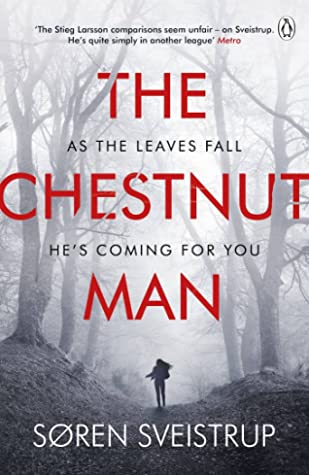
His calling card is a “chestnut man”—a handmade doll made of matchsticks and two chestnuts—which he leaves at each bloody crime scene.
Examining the dolls, forensics makes a shocking discovery—a fingerprint belonging to a young girl, a government minister’s daughter who had been kidnapped and murdered a year ago.
A tragic coincidence—or something more twisted?
To save innocent lives, a pair of detectives must put aside their differences to piece together the Chestnut Man’s gruesome clues. Because it’s clear that the madman is on a mission that is far from over. And no one is safe.

This is the kind of crime thriller that has you permanently transfixed and glued to the edge of your seat, such is its brilliance. Exceptionally dark and with a chilling atmosphere that creates electrifying tension throughout, it delivers a truly pulsating narrative that never lets up with its constant supply of remarkable twists and turns.
It is absolutely not for the faint hearted as it depicts some of the most heinous crimes in unsettling detail, but as far as the story goes, you will not find many that are quite as gripping as this one. The characters are developed impressively and come into their own alongside a plot which takes centre stage; executed to something close to perfection right up to its dramatic conclusion.
Inspector Mark Hess has just arrived from Europol to work as a homicide detective in Copenhagen, where he is immediately regarded with suspicion by his colleagues, including his new investigative partner, Thulin. Meanwhile, the minister for social affairs Rosa Hartung has just returned to her post, a year on from the disappearance of her daughter Kristine. A man was convicted after confessing to the girl’s murder, but a body has never been found.
When a woman is found brutally murdered, Hess and Thulin are called to investigate. There are no obvious suspects and the only piece of forensic evidence is both remarkable and puzzling – a chestnut figure left crudely at the scene by the killer, bearing a fingerprint which matches that of Kristine Hartung. Despite Hess’ repeated insistence, her case is not reopened.
This marks the beginning of a reign of terror as the killer strikes twice more, again leaving chestnut men at the scene and showing increasing levels of barbarity. Hess and Thulin work tirelessly to try and understand the motive behind the murders and eventually establish a connection between the victims, with Rosa right at the heart of it. However, the killer proves extremely elusive and is ruthlessly intent on throwing the investigation off course.
After an ominous prologue, there is much intrigue to be found in the beginning as several characters and plot strands are introduced, and there is not long to wait until the first of the murders takes place. From there, it is an utterly compelling and unputdownable ride as the case moves in all kinds of directions, lifting the stakes and suspense levels beyond measure.
The actions of the killer and the signature chestnut man motif are terrifying, and the plot throws up some suspects along the way including the occasional red herring, but the lack of genuine clues until very late on really adds to what is a menacing atmosphere. Despite the best efforts of Hess and Thulin, they are always one agonising step behind, which leaves you to wonder how the killer would wrong-foot them next.
If there is anything minor to criticise about the plot, it is that the killer’s motive could have been made slightly clearer, and some of the clues the police came upon towards the end were a trifle convenient. However, those things take absolutely nothing away from the magnificence with which it is all woven together, with all the many dimensions of the story falling effortlessly into place and leaving a lasting impact.
The entire book is written in the third person past tense, from a multitude of perspectives but with a primary focus on Hess and Thulin. It took some time to really get to know the characters well, but in the end this happens naturally as the case progresses and given the urgency of the plot, I did end up feeling a connection to the main protagonists – especially Hess.
There is something quite mysterious about Hess to begin with, as we know little about who he is and why he has been sent away by Europol, but his unshakeable determination and innate empathy ultimately set him apart. While he might be something of a maverick who employs some unique methods of detective work, it is impossible not to be fully immersed in his personal crusade to track down the killer.
Thulin is a bit short-tempered and not particularly likeable at first, but she definitely grew on me as her working relationship with Hess became more cordial, and she does have a heroic role to play at the end. The commanding officer Nylander is more frustrating due to his pride and stubbornness, whereas Rosa Hartung is remarkably spirited for the entirety of her rather traumatic story.
Although the emphasis is on the plot, the novel always retains a sense of place, with the Danish setting enhanced by the portrayal of its politics and demographics. The most noticeable cultural aspects are the chestnut men themselves, which are so synonymous with the book. In addition, the severity of the crimes and the fact it is so dark means the unsettling atmosphere is omnipresent.
The storytelling is very skilful, full of intensity and alive with suspense. I was completely immersed by it, unable to stop reading through a desperate need to find out what happens next, and only the best crime novels can do that. As if any more of an incentive is needed to read on, the chapters are quite short, with most of them only a few pages in length. Each one of them is packed with depth and keeps the plot simmering along.
Overall, this is an extraordinary book in terms of both quality and scale. The detail on show and the intricacy of the narrative represent impressive achievements, and there is never a point where it is anything other than addictive. It is dark and frightening and the crimes of the Chestnut Man are so horrific, but it has to be said, this story is simply breathtaking.

As mentioned in the review, this book is extremely dark and as such there are a lot of content warnings involved. Most of these revolve around the murders themselves as there are descriptions of violent acts, injury detail, and dismemberment.
Elsewhere, it also contains references to severe child sexual abuse, intermittent sexual content, a missing child storyline, misogyny, and animal death.

Søren Sveistrup is best known for creating the internationally acclaimed Danish television series The Killing, a crime drama which has won numerous awards and been sold to more than 100 countries. His other screen work includes an adaptation of Jo Nesbo’s novel The Snowman.
However, he has turned his hand to writing books with The Chestnut Man, which is his debut novel and has recently been adapted by Netflix. He possesses a degree in Literature from the University of Copenhagen along with one in history, and studied at the Danish Film School.

I have not read much Nordic noir and certainly not many novels quite as dark as this, but The Chestnut Man is the best and most gripping crime thriller I have read in a long time. I was fully immersed in the story from start to finish and never really wanted to put it down.
My rating: ⭐⭐⭐⭐⭐
Thank you to Ellie @ Read To Ramble for buddy reading this one with me. I really enjoyed discussing it and we were both very much along for the ride!

 Stephen Reads Books