Pages: 401
Published: 27th January 2022
Genre: Historical Fiction/Magical Realism
Content warnings: Domestic violence, sexual references, references to psychological abuse
This was a buddy read with my friend Pauliina, and once again while it did not turn out to be the five-star read we are searching for, we still had a wonderful time reading it. She has such great thoughts and perspectives, so we always have lots of fun, interesting discussions during our buddy reads and this was no exception!
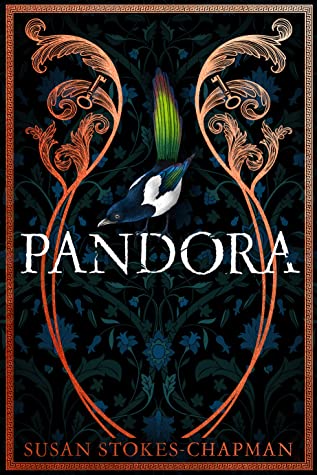
London, 1799. Dora Blake is an aspiring jewellery artist who lives with her uncle in what used to be her parents’ famed shop of antiquities. When a mysterious Greek vase is delivered, Dora is intrigued by her uncle’s suspicious behaviour and enlists the help of Edward Lawrence, a young antiquarian scholar. Edward sees the ancient vase as key to unlocking his academic future. Dora sees it as a chance to restore the shop to its former glory, and to escape her nefarious uncle.
But what Edward discovers about the vase has Dora questioning everything she has believed about her life, her family, and the world as she knows it. As Dora uncovers the truth she starts to realise that some mysteries are buried, and some doors are locked, for a reason.

If this book had a more fully fledged plot to go with its immense artistic merit and extraordinary writing style, then it would be an absolute masterpiece. Atmospheric and stunningly immersive from the very first page, it paints the most vivid of pictures while exploring fascinating concepts and introducing us to a range of compelling characters, yet these things do not mask all of its flaws.
It is primarily a historical fiction, but with rather enticing elements of Greek mythology that give it that little bit of extra intrigue. These transpire to be more akin to magical realism than fantasy and along with the double meaning of the title, bring a lot of promise that something mesmerising awaits at the end. There is certainly lots to enjoy, only the mythology merely exists within the narrative rather than being the thing around which it is based.
The year is 1799 and after the death of her parents twelve years earlier at the site of an archaeological dig, Pandora Blake is living with her uncle Hezekiah at Blake’s Emporium, a shop selling antiquities and other curious cultural artefacts. The goods Hezekiah sells are mostly forgeries or items obtained illegally, and Dora spends much of her time in her attic room feeling unloved with only her pet magpie Hermes for company, harbouring aspirations to be a renowned jewellery designer.
Meanwhile, Edward Lawrence is a bookbinder with a passion for material culture, determined to overcome his less than privileged upbringing to gain acceptance into the prestigious Society for Antiquaries. In a coffee house one afternoon, he is approached by a mysterious old man who directs him to Blake’s Emporium to speak to Dora, explaining that she might be able to help him in his endeavours.
At around the same time, Hezekiah takes the delivery of a large item which he stores in the shop’s basement and attempts to hide from Dora. However, she manages to get inside and there she discovers an enormous Grecian jar known as a pithos, with illustrations depicting the legend of Pandora. Something about it seems alive and she wonders what is inside. Then she meets and becomes close friends with Edward, and they begin working together in order to unlock the truth about the pithos.
There is so much packed into this story and every detail is a joy to read, but while the pithos maintains a constant presence and at first seems to be front and centre of everything, it ends up playing somewhat second fiddle to Dora’s jewellery venture and her burgeoning relationship with Edward. Although these other plotlines are perfectly okay, the pithos and its mystique are given such attention early on that it creates false expectations.
Those issues aside, the plot as a whole is brimming with depth and all the topics it covers from jewellery to mythology to antiquities, have been impeccably researched. It takes some unexpected directions as certain characters are introduced and despite the flaws you always look forward to finding out what is going to happen next, especially as Edward learns more about the origin of the pithos and Hezekiah grows increasingly desperate to uncover its contents.
The author still manages to devote a lot of time to character development, and Dora in particular is given a lengthy backstory. This does mean that some sections involve telling rather than showing, but that felt appropriate as an extra timeline would have made things over-complicated – indeed the pacing felt just right all the way through. What was slightly more frustrating was that some important events happened off the page and we are only told about them afterwards, rendering them less impactful.
All of it is written in the third person, focusing on the three separate perspectives of Dora, Edward, and Hezekiah. This worked well and brought a good degree of contrast, with the tone of Hezekiah’s chapters noticeably darker than the others and providing more of an insight into his motives. Also, the storylines of Dora and Edward compliment each other nicely as they are both enduring difficult lives until they meet.
Dora is a character made more interesting by her family history, but is likeable and over the course of the book develops a strong level of independence. That, and the growing success of her jewellery designs, make you really start to root for her as she emerges from her uncle’s oppression. The fact she has a pet magpie also adds that little bit of quirkiness.
As for Edward, his story is fairly moving in places and he comes across as shy and unassuming. He is caring and kind-hearted, although he does become a bit too over-protective of Dora as his feelings for her grow. If you were instead hoping for Edward to be involved in a romance with his friend and benefactor Cornelius – as is heavily implied at the start – then you will be left disappointed.
Indeed, Cornelius is an entertaining character to read and it was a shame that he did not receive a happy ending. He is sharp-witted and in front of an oblivious Edward, never makes any attempt to hide his jealousy towards Dora, creating many of book’s lighter moments. Lady Latimer was also highly memorable; haughty in the extreme and with an enormous sense of entitlement, yet not without the occasional hint of generosity.
Hezekiah comes across as brutish for the most part and is generally a very unpleasant person, but he is also quite scheming and becomes more dangerous as the story goes on. His maid Lottie is a similarly unlikable character to begin with, but she is given an excellent arc and is more or less fully redeemed by the end.
The historical time period and the Georgian London setting are reflected really well by the atmosphere that prevails throughout and the meticulous attention to detail. The attention given to the study of antiquities and the descriptions of things such as Dora’s jewellery, the objects at Blake’s Emporium, and Lady Latimer’s soiree, all help to give the story even more depth.
That is just one example of how the writing is simply outstanding. The author’s prose is a delight to behold, as sentences are weaved together with such beautiful refinement and lyricism, including lots of similes and personification. It is this more than anything that makes you want to keep reading, and for a debut author that is seriously impressive.
As far as the ending goes, that was rather less polished. Some things happen fairly randomly and others were not clearly explained, giving a minor impression that the author was making some of it up as she went along. There were some good twists and revelations along the way, but one or two others did not feel quite right in the context of the story.
Overall, the pure majesty and utterly absorbing quality of the writing makes this book enjoyable, even if the execution of the plot does leave one or two things to be desired. The concept is great and it at least remains intriguing to the last, creating anticipation for each new chapter. It excels in a number of areas, but is just rather rough around the edges.
Raised in Lichfield, Susan Stokes-Chapman studied for four years at Aberystwyth University in Wales, completing an undergraduate degree in Education and English Literature before doing a Master’s in Creative Writing. Pandora is her debut novel and was shortlisted for the Lucy Cavendish fiction prize in 2020, but was not released until 2022.
I shall be seeing Susan at an event in May, which I am excited about as it will be super interesting to find out more about what went into writing Pandora. Hopefully she can also discuss her approach the topic of antiquities and how they were basically stolen from their countries of origin in the past, something that the book itself barely confronts.

As I was reading the first 100 pages, I felt confident that this could be a five-star read. But while the writing remained superb, some imperfections emerged in the plot which created a few issues. Still, as a reading experience, I enjoyed it.
My rating: ⭐⭐⭐.5

 Stephen Reads Books