Pages: 416
Published: 31st March 2020
Genre: Historical Fiction
Content warnings: Misogyny, sexual content
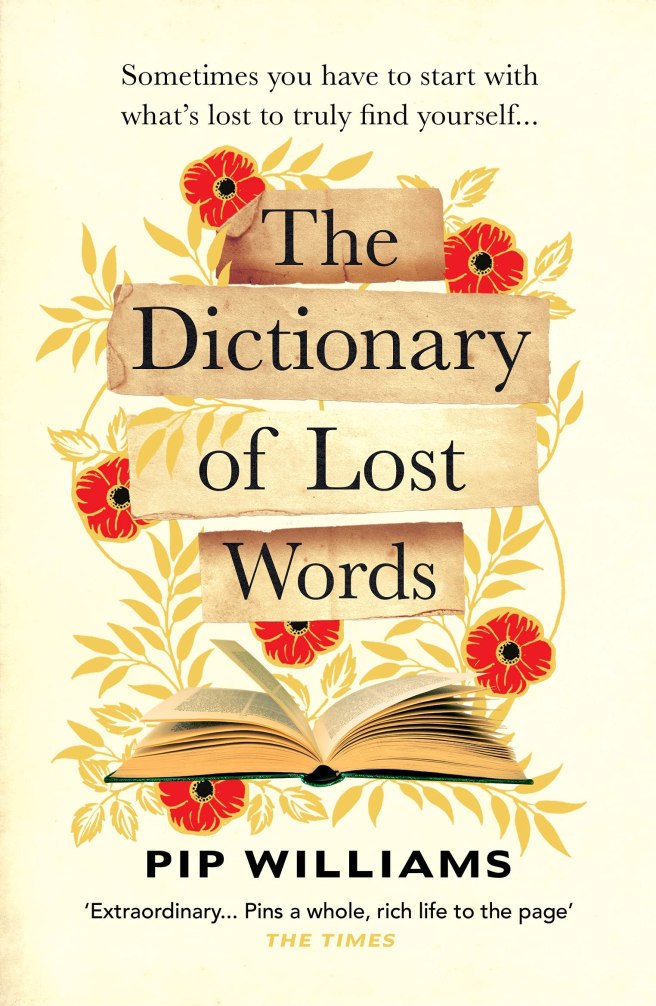
Motherless and irrepressibly curious, Esme spends her childhood at her father’s feet as he and his team gather words for the very first Oxford English Dictionary. One day, she sees a slip of paper containing a forgotten word flutter to the floor unclaimed.
And so Esme begins to collect words for another dictionary in secret: The Dictionary of Lost Words. But to do so she must journey into a world on the cusp of change as the Great War looms and women fight for the vote. Can the power of lost words from the past finally help her make sense of her future?

This is a veritably poignant and well imagined coming of age story that immerses you in vivid detail in a timeline spanning several decades, eloquently portraying a succession of life-defining events to very good effect with the mere power of words. Told with great subtlety and possessing an endearing set of characters, some of whom are based on real people, it leaves an impact by exploring the gradual passage of time alongside an underlying social commentary.
Anyone with a love of words or linguistics will be thoroughly enchanted as definitions and derivations act as the very essence of the book and are the inspiration for a number of scenes. For the most part this is handled well and they also play a major role in establishing some of the key themes, such as how certain words have historically reinforced class divisions or given rise to gender inequality, with the suffragist movement featuring heavily in the plot.
Esme Nicoll’s father works as a lexicographer, part of a group led by Dr James Murray with the aim of compiling the Oxford English Dictionary. They spend their days in a cavernous room known as the Scriptorium, slowly working through the meanings of each and every word, all of them kept on slips with accompanying literary quotes. As Esme sits captivated beneath her father’s desk, she witnesses the men debate the legitimacy of words and soon endeavours to take some of the rejected words as her own.
She takes some of these slips and places them in a suitcase that she hides away in her maid Lizzie’s bedroom, naming it the Dictionary of Lost Words. After an ill-fated stay at a boarding school in Scotland, Esme returns to Oxford and begins to take on responsibilities in the Scriptorium, running errands and becoming enthralled by all the words at her fingertips.
When she goes along with Lizzie to the covered market, Esme learns another aspect of the English language, far removed from what was being approved for the dictionary. She documents those new words herself and also becomes close to Tilda, an actress and a prominent member of the local suffragist movement. This friendship not only challenges her worldview, but leads to a defining and traumatic period in her life which she recovers from, but leaves permanent scars.
The most wonderful thing about this story was how words and their definitions played such a deep and overarching role, something that was never lost during even the most emotional parts of the plot. It was interesting to see it chart the slow progression of the dictionary from A to Z, witnessing all the comings and goings at the Scriptorium and the character development. All the time, Esme’s life is compelling.
It gets off to such a cosy and whimsical start that really captures your imagination, but things take a more serious turn once Esme returns from Scotland. There is more of an edge to the book after this point and although I did not enjoy the occasional emphasis on some unsavoury words, it makes for an effective way of showing how the voices of certain groups in society are treated with less importance than others.
As we go further into Esme’s story, some uplifting things happen, but she also suffers her fair share of heartbreak. These moments sometimes happen quite suddenly and as the reader you have to come to terms with them, while a few things are just implied rather than relayed in a lot of detail. It makes them more powerful in a way even if it leaves you wanting more.
The timeline is a long one, stretching from the late nineteenth century and with chapters spread across the following decades right up to and including the First World War before an epilogue set in 1989. Throughout the course of that the story is developed beautifully and at a relatively calm pace, and I enjoyed the build up of Esme’s relationship with Gareth, and the reassuring constancy of the letters from Ditte.
With the exception of those letters and the epilogue, everything is written in the first person from Esme’s point of view. In a way her voice is a little understated, but there is a certain weight to it that provides a profound degree of emotional depth, something which becomes more pronounced during the more tragic or bittersweet parts of her life.
More than anything however, her curiosity and love of discovering new words and their meanings shines through. She is extremely innocent to begin with and that catches her out once or twice, but I really liked how she stuck to her principles and fought her own personal battle for equality, emerging from times of difficulty while always maintaining a sense of youthfulness. In general, she is a really impressive protagonist.
Esme’s relationships with other characters was one of the main highlights. Each interaction she shared with her father was heartwarming, and it was clear to see how strongly Ditte cared for her too. The seed for Gareth was planted relatively early on, but he only becomes significant much later in the story and it was nice to see how that was developed. What is more, he is likeable, full of respect and understanding.
One of the most important and symbolic characters was Lizzie, whose role as a maid is used often to examine the theme of class divisions. For all of that, she is multi-layered and nuanced, as well as very amiable. Tilda was the total opposite, with a forceful personality and strong-held beliefs, while Mabel was memorable for her unapologetic coarseness. The many lexicographers who work in the Scriptorium over the years are also brought to life well, notably Mr Crane and Mr Dankworth.
Being set in Oxford is enough to enhance any book and we see a few sides to the city here, from the more elite surroundings of the university and Bodleian Library to places such as the covered market. The main locations are displayed on a helpful map inside the front cover, and the most interesting of those is undoubtedly the Scriptorium, which is perhaps not as glamorous as it sounds but is still made to feel like a bit of a treasure trove.
The writing is very detailed, yet at the same time the words do all the talking and Esme’s narration leaves no room for dramatic effect. This matter-of-fact tone serves the plot well and gives it a higher level of authenticity as it moves slowly through the years. The historical events are woven into proceedings neatly and the whole experience of learning more about when the Oxford English Dictionary was published was a super interesting one.
Overall, an accomplished and sophisticated story that is capable of stirring great emotion, all driven by an excellent narrator. I did not enjoy everything about the plot, but in the main it does succeed due to the strength of its themes and character development throughout an arresting timeline. It contains a lot of things you cannot fail to love, and it most definitely leaves an impact.
Originally from London but now living in Adelaide having spent most of her life in Australia, Pip Williams has written on a range of subjects. Along with poetry, flash fiction, and travel articles, she wrote a memoir of her family’s travels called One Italian Summer. This was published in 2017 and received very positive reviews.
Also the co-author of Time Bomb: Work Rest and Play in Australia Today, she released The Dictionary Of Lost Words in 2020, which is her first novel for adults. It was nominated for the Walter Scott prize in historical fiction in 2021.
I loved the opening to this book and became thoroughly immersed in how the story developed, hence how it felt so poignant. There were some moments in between which were not always to my taste, but generally it is a very impressive coming of age novel.
My rating: ⭐⭐⭐⭐

 Stephen Reads Books