Pages: 297
Published: 1st November 2022
Genre: General/Literary Fiction
Content warnings: Grief, sexual references, drugs
This was a buddy read with my friend Kriti @ Armed With A Book, and we both enjoyed this book and discussed it at length. Spoiler-free extracts of our discussion can be found after my review.
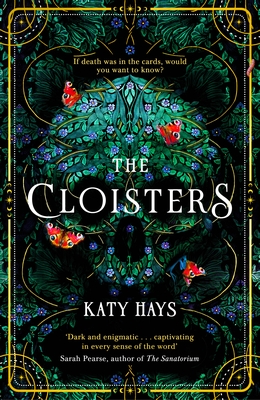
Ann Stilwell arrives in New York City, hoping to spend her summer working at the Metropolitan Museum of Art. Instead, she is assigned to The Cloisters, a gothic museum and garden renowned for its collection of medieval and Renaissance art.
There she is drawn into a small circle of charismatic but enigmatic researchers, each with their own secrets and desires, including the museum’s curator, Patrick Roland, who is convinced that the history of Tarot holds the key to unlocking contemporary fortune telling.
Relieved to have left her troubled past behind and eager for the approval of her new colleagues, Ann is only too happy to indulge some of Patrick’s more outlandish theories. But when Ann discovers a mysterious, once-thought lost deck of 15th-century Italian tarot cards she suddenly finds herself at the centre of a dangerous game of power, toxic friendship and ambition.
And as the game being played within the Cloisters spirals out of control, Ann must decide whether she is truly able to defy the cards and shape her own future…

This is a deeply thoughtful and immersive book that gradually ensnares you until the point where it has your full undivided attention. With its authentic level of detail and scholarly narrative, it succeeds by expertly developing a clutch of arresting characters and themes, along with bringing to life a setting that exudes majesty while hiding many secrets within.
A fine example of contemporary literary fiction, the story focuses largely on the subject of tarot card reading, and the author’s extensive knowledge of this shines through. It may seem quite niche, but the way it is incorporated as a central element of the plot makes it such a compelling read even for divination sceptics like me, giving way to fascinating philosophical commentaries on academia and personal relationships.
Ann Stilwell is a graduate student from the city of Walla Walla in Washington state, who has been struggling to come to terms with her father’s death a year earlier. Despite her mother’s pleas, she is desperate to escape a place she feels holds nothing for her, and she secures an internship at the Metropolitan Museum of Art in New York. When she arrives, she is told that it is no longer available, but luckily curator Patrick Roland happens to be passing. On the spot, he invites Ann to join him at the Cloisters.
Although the transition to living and working in New York takes some getting used to, Ann finds herself in awe of the Cloisters immediately and revels in the opportunity to devote her life to her passion of studying art history. Patrick encourages her to work with an open mind and view the cards as if the messages contained in them are true, but all the while he is impatient to make that groundbreaking discovery.
Over the course of the summer, she starts a relationship with the Cloisters’ streetwise gardener Leo and becomes increasingly close friends with her privileged colleague Rachel, who takes Ann under her wing. After sharing a significant breakthrough and keeping it hidden from Patrick, they then take part in a risky night-time experiment that results in a shocking turn of events.
The pacing of the story may take a bit of time to gather some momentum, but it is intriguing right from the get-go as you experience Ann’s journey right alongside her. As it progresses, new themes are delicately introduced and explored at great length, advancing the plot while also being faithful to the divination topic. There is a lot of talk about tarot and history of art, but it feels like just the right amount without going too in-depth.
Whereas the first half skilfully lays the foundations, an unexpected twist just past the halfway mark sets the tone the remainder of the book, which goes from addictive to utterly mesmerising by the end. The addition of a mystery gives everything a whole new dynamic, and that is where the strength of the themes and character development comes into its own, for we get to see everyone’s true colours as well as a hint towards the power of the cards.
Everything is told in the first person from Ann’s point of view, and notably she is recalling all the events in the past tense after they have taken place. Her unique voice is formal and delivered in relatively academic prose, which may seem somewhat distant and unengaging, but I actually found it engrossing and in many ways, relatable.
You really do get a sense for how Ann’s mind ticks, and the insecurities she feels upon her arrival at the Cloisters. The grief she feels at her beloved father’s death; her absolute passion for her work; constantly comparing herself with the affluent and unflappable Rachel. That friendship and how it evolves is so incredibly fascinating, by the way. But above all, you get to witness her growing single-mindedness and independence towards fulfilling her ambitions.
The excellent character development does not end with Ann. At first, Rachel seems without a care in the world and almost robotic in her perfection, but as you get to know her the cracks start to appear. She can be described as morally grey and her lack of close friends turns out to be quite revealing. Her relationship with Patrick is alluded to rather than clearly shown, but you are left in no doubt that it is all on her terms.
Talking of Patrick, he comes across as charming to begin with but becomes more reckless in the name of his research. The fascinating thing about Leo is that he is wayward yet resourceful, which made him charismatic. I also really enjoyed the few scenes with Aruna, who is kind of the opposite of Patrick and always has wise words for Ann.
While the book is set in contemporary New York, it often has the feel of a historical fiction. This is partly down to the writing style, but also the Cloisters itself. The place has an air of magic to it, due to the way it is depicted through Ann’s eyes. Everything about it from the voluminous library where she conducts her research, to the architecture and the history, just illustrates its beauty and provenance. As a reader, it is a sensory delight.
There are not many criticisms to make, but it would have been good if some elements of the plot had been expanded upon. The prime example of this is the storyline between Ann and her mother, which is left unresolved. Other than that, the ending is as thought-provoking as it gets and serves to tie up several of the book’s themes all at once.
Overall, a concept that is full of originality comes together as a tremendously executed story. Once all the setup is over and it really starts to get going, it becomes remarkably difficult to put down, such is the quality of the character dynamics and how they all combine to produce a mystery of escalating menace. Academic and authentic, it is certainly a hard one to forget.
Discussion
End of chapter 14 (halfway)
Kriti: I am worried about Ann’s mom and the relationship, or lack of, the two of them have. I hadn’t expected the book to go into grief and bereavement but it makes sense and this is adding more dimensions to Ann. For a young woman who is suffering from the loss of her father, supporting her mother too is a huge task, and it is not surprising to me that Ann avoids it.
Stephen: I think the author is handling this topic very well. Ann’s reaction seems natural, but it is sad that they cannot find a common ground. It seems like her mother wants to rely on Ann to support her, but Ann’s grief has made her want to distance herself from family matters, and also live her own life to an extent. It is a complex one but I really like the mature, understated way it is being explored.
KK: I am finding the descriptions of the building and the places really well done! Even though the book is set in modern times, the feel is very historical fiction because of Tarot and the era Patrick, Ann and Rachel are trying to investigate in. What do you think of the setting and world building, Stephen?
SD: I agree, Kriti! Sometimes I am having to remind myself that it is contemporary fiction rather than historical, because of the writing style, settings, and what Ann, Patrick, and Rachel are studying. It is like a world within a world and I love it!
In terms of how The Cloisters is depicted, you can see Ann’s (and the author’s) love for and connection to it in every description. Ann is completely in awe of her surroundings when she is there – the history, the architecture, the voluminous library; all of its beauty and provenance. Although I am not an academic, I think I would be in awe of the place too.
The other main thing about the settings in this book is the obvious contrast that is being made between Walla Walla and Ann’s new home in New York. The two are so different and there are things that Ann wasn’t prepared for, but now she seems enthralled by the city.
KK: In many ways, this feels like a slice of life. Ann mentions constantly that she is unable to decipher reality from dreams. The death of her father has affected her deeply and I am starting to wonder if she is a reliable narrator. But at this point, nothing has really happened to make me think too much about this. What do you think of Ann’s perspective?
SD: What I like the most about Ann’s perspective is that even though it is very formal and clinical, it is also compelling and relatable. You can feel her insecurities and how she yearns to fit in with New York, as we can see in her interactions with Leo and in particular, Rachel.
I hadn’t considered the possibility that Ann could be an unreliable narrator, but you might have a point! What I certainly find interesting as that she is narrating events in the past tense, after they all happened. So in that case, we could only be getting her version of events.
KK: That’s a great point. We know from the prologue that the events of the summer have already happened.
SD: What do you think of Ann? Do you find her likeable, and have you been able to identify with any of the challenges she has faced so far?
KK: I like Ann. At such a young age in her life, she has already had some very hard experiences and she is learning to navigate in the world in a way that keeps her safe. I was reminded of when I first moved away from home, into my own space and had the freedom to spend my time doing what I wanted. Academia has those moments of sheer concentration, for example when we are trying to write a paper or edit a thesis. Though Ann was working at a museum, everything still felt very academic. With that comes the challenge of making a name, being someone. There are only so many jobs out there. And we are all working very hard to be seen. Did you find Ann relatable?
SD: In some ways, definitely! I could relate to Ann feeling slightly intimidated by Rachel’s more privileged background to begin with and the imposter syndrome that brought her. Also if I walked into the Cloisters and got to work there, I would have been just as excited about my surroundings as she was, although I am not an academically focused person.
The end of the book
SD: Rachel may have been privileged and had relationships with Patrick and Leo, but she didn’t seem to have any close friends. To what extent do you think this was because of how she prioritised her academic research, or because of her general personality?
KK: I feel like it was a combination of both. As an ambitious woman who is good at her research, it would be hard to make friends who weren’t going to challenge her position. Her experiences with her parents probably didn’t make her very receptive to trusting people.
What did you think of Ann’s use of the cards in the second half of the book? As she interacted with the cards more, I felt that the writing conveys the beauty and magic of them. Ann was fascinated and really taken in by them. I enjoyed those descriptions and what her interpretation of the cards meant for the characters and what the future had in store for them.
SD: As Ann began to feel more at home working at the Cloisters, spending time with Patrick and Rachel, she became more inspired. Patrick’s willingness to believe the messages in the cards opened her mind, and together with the circumstances of her father’s death, informed her interpretation of the cards. The cards definitely seemed to have a magic about them, especially after we learnt about the hidden layer beneath. The writing captures the beauty of them, and the author’s knowledge of the subject matter shines through.
One of the reasons why this book is so authentic is that Katy Hays is a history of art scholar herself, completing her studies at Williams College and at University of California Berkeley, where she did her PhD. She now works as an adjunct professor, teaching rural students.
This is her first novel, having also worked at art institutions including the Museum of Modern Art.
In my opinion this book deserves much better than it’s average rating on Goodreads. It is not perfect, but at times it was outstanding and I was absorbed by it.
My rating: ⭐⭐⭐⭐

 Stephen Reads Books