Pages: 383
Published: 12th May 2020
Genre: Young Adult Contemporary/Romance
Content warnings: Racism/micro-aggressions, homophobia
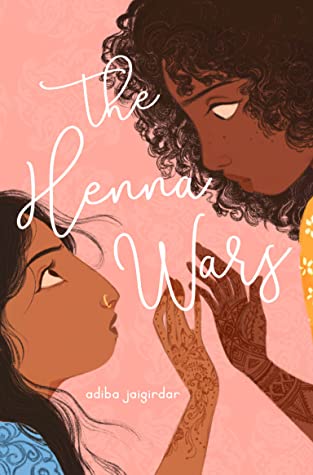
When Nishat comes out to her parents, they say she can be anyone she wants – as long as she isn’t herself. Because Muslim girls aren’t lesbians. Nishat doesn’t want to hide who she is, but she also doesn’t want to lose her relationship with her family. And her life only gets harder once a childhood friend walks back into her life.
Flávia is beautiful and charismatic and Nishat falls for her instantly. But when a school competition invites students to create their own businesses, both Flávia and Nishat choose to do henna, even though Flávia is appropriating Nishat’s culture. Amidst sabotage and school stress, their lives get more tangled – but Nishat can’t quite get rid of her crush on Flávia, and realizes there might be more to her than she realised.
This book is so truly adorable that it captures your heart as well as your imagination with minimal effort. Featuring a wonderful sibling relationship to go with the cute sapphic romance at its centre, it is engagingly written and tells a story that is both empowering and entertaining as important topics are handled alongside a broad cultural awareness.
It is perhaps aimed slightly more towards the teenage end of young adult spectrum and although some might say objectively that it is not perfect, you will be hard pushed not to fall in love with it at a very early stage – just like I did. The concept of using henna as a key element of the story is inspired and the main characters are a delight to read about, cultivating that sense of emotional investment.
One of the most striking things about the story is how Nishat comes out to her parents right at the beginning, and that works really well as it sets up her journey towards gaining acceptance. It is quite moving to see that particular plotline develop and how much isolation she has to face, but it never loses its sense of optimism and a happy ending always seems within sight, even if there are a few false dawns along the way.
It is obvious from early on that there will be some kind of romance between Nishat and Flavia, but what makes it intriguing is how they are competing – in some ways bitterly – against each other in their school project, which clearly means a great deal. Yet while there might be things that strain their budding relationship, every direct interaction between them is just the sweetest thing.
The only complication about Flavia is that she happens to be the cousin of Chyna, who spreads nasty rumours and is basically Nishat’s sworn enemy. That comes between them a little, but Flavia is just such a lovely, thoughtful person and that really shines through. Indeed, this romance just illustrates how beautifully down to earth this story is.
Just as good if not better is the sibling dynamic between Nishat and Priti, which melts your heart in a different way. Their bond is unbelievably close and they are always there for each other, all while maintaining an easy-going, light-hearted relationship that is full of humour and wit. The way Priti looks out for Nishat is everything you could possibly wish for, and the two of them are just so likeable.
Nishat and Priti attend a Catholic girls’ school and they have had to fight hard to gain acceptance, an issue that turns into something more problematic when Nishat’s sexuality becomes common knowledge and you are seriously rooting for her. Apart from that select few, a lot of their classmates actually seem quite innocent and their dialogue is perhaps a bit more mature than how you might expect teenagers to speak, but that is not a bad thing.
If there is anything to criticise about the plot, then it is the fact is gets a tad repetitive as it goes on, causing the book to lose a little of its spark. However, there is rarely a time where you do not feel invested and the writing style really helps it along; light and full of energy but eloquent and measured where it needs to be. The use of Bengali and Portuguese at various points is also a great enhancement.
The use of henna as a plot device works so well and the author approaches it with a level of detail that is in depth but equally, not too exhaustive. It is given the respect it deserves as a cultural staple and acts as another way for Nishat to develop as a character throughout the story. There are some lovely moments such as the Skype calls with her Nanu, and when classmates go to her stall discover her talent for themselves.
On a somewhat more random note, something that really stood out for me in this book were the aesthetics. The floral henna patterns marking every page and section break are gorgeous, and there is even something about the typeface that makes it so attractive to read. The text also includes some popular culture references, including quite an amusing one about Niall Horan of One Direction.
Overall, young adult contemporary romances surely do not get much cuter than this. Nishat is such a good character to spend time with and when you are not revelling in her sisterly connection she shares with Priti, you will be enjoying her burgeoning relationship with Flavia and urging her parents to show her some love. Add to that the unique concept of the henna, then it is a winning combination.
Just like Nishat and Priti in this book, Adiba Jaigirdar was born in Bangladesh before moving to Dublin as a child. She received her undergraduate degree in English and History before completing an MA in postcolonial studies, and has since become an author.
The Henna Wars was her debut novel, released in May 2020 at the height of the pandemic, but its story and representation has brought it a lot of positive recognition. Her second novel, Hani and Ishu’s Guide To Fake Dating, was published a little over a year later.
I fell in love with this book very quickly and although it did get a bit repetitive in parts, that feeling never really diminished.
My rating: ⭐⭐⭐⭐

 Stephen Reads Books