
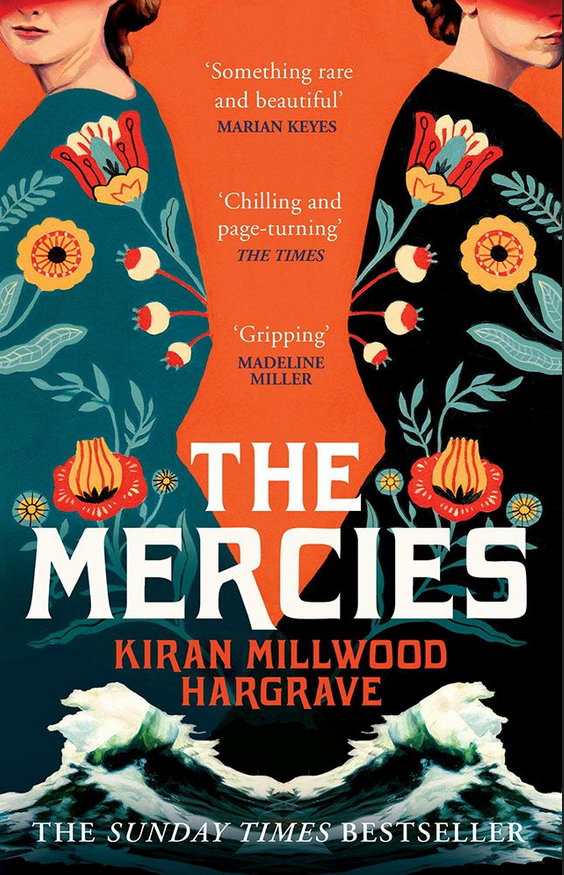
Pages: 343
Published: 6th February 2020
Genre: Historical Fiction
Content warnings: Violence, Rape, Sexual references, Misogyny

Finnmark, Norway, 1617. Twenty-year-old Maren Bergensdatter stands on the craggy coast, watching the sea break into a sudden and reckless storm. Forty fishermen, including her brother and father, are drowned and left broken on the rocks below. With the menfolk wiped out, the women of the tiny Northern town of Vardø must fend for themselves.
Three years later, a sinister figure arrives. Absalom Cornet comes from Scotland, where he burned witches in the northern isles. He brings with him his young Norwegian wife, Ursa, who is both heady with her husband’s authority and terrified by it. In Vardø, and in Maren, Ursa sees something she has never seen before: independent women. But Absalom sees only a place untouched by God and flooded with a mighty evil.
As Maren and Ursa are pushed together and are drawn to one another in ways that surprise them both, the island begins to close in on them with Absalom’s iron rule threatening Vardø’s very existence.
Inspired by the real events of the Vardø storm and the 1620 witch trials, The Mercies is a feminist story of love, evil, and obsession, set at the edge of civilization.

Sometimes it is the hope that kills you, and that is the case surrounding this book. There is very little actual happiness to be found, only the potential for it, amid a frightfully gloomy landscape of tyranny and persecution which leaves you craving a happy ending that never arrives. Beautifully written and with a fierce level of atmosphere, the overriding impressions for the trajectory of the plot are a fascinating combination of powerful yet slightly unfulfilling.
Partly inspired by true events, it plants the idea of characters gaining freedom and independence with storylines of female empowerment and forbidden love, but it is ultimately grounded in the cold hard heartbreaking realities of the historical setting. Through the eyes of its two innocent protagonists, it is a world conjured by a nightmare where the only glimmer of light they have is each other, and the author captures their emotions with the utmost elegance.
The plot is something of a slow burn initially as it takes a few chapters to get fully accustomed to the lyrical writing style and the various dynamics of Vardo, but once Ursa is introduced along with her villainous new husband Absalom Cornet, it starts to take shape and gather some momentum. From there, it develops into an increasingly tense and gripping read in which trepidation is never very far away.
As Cornet runs the rule over Vardo and divisions begin to emerge among the women, all left to fend for themselves after their husbands were swept away by a storm, it gets very unsettling. With accusations of witchcraft floating around and Cornet’s mission being to stamp out any signs of improper activities in the strongest possible terms, it feels like he might unleash his true colours at any moment. But when he does, he goes much further than you could possibly imagine.
Under his rule, the women lead an extremely fragile existence with other characters such as Toril and Sigfrid stirring up tensions in Vardo. It becomes a real melting pot of fear and the eventual fates the accused women suffer are nothing short of harrowing, while the whole narrative serves to illustrate what a tragic set of absurdities witch trials were in centuries gone by.
Caught up in the middle of all this are Maren and Ursa, and the seeds are sown early for a bond that goes beyond mere friendship. The tentative romance that simmers between the two of them is really adorable as it takes so long for either to acknowledge it, but there is terror and suspicion all around them. That they are both somewhat alone in the world also makes them inseparable.
Ursa is sweet and vivacious in the moment we meet her, before she suffers the misfortune of being bestowed upon Cornet as his new bride. This new life is immediately unhappy and uncomfortable, but once she realises what kind of a man he is, she pleasingly stands her ground. She is someone with an inner resolve and a great sense of conviction, and of the two main characters Ursa is easily the more proactive.
Also written in the third person perspective, Maren has more of a nervous disposition and although she cannot deny her feelings for Ursa, she struggles to come to terms with them. Both are easy to root for and the same applies to the likes of Kirsten and Diina, who find themselves cast under increasing suspicion as the net closes in on them. These two main plot strands are subtly developed throughout, and then gather serious momentum in the final third of the book.
The early signs are that Cornet is a nasty piece of work, summoned by the bloodthirsty Lensmann Cunningham to run the rule over Vardo. He is a little complex at times and the scene where he and Ursa visit Cunningham is especially compelling when you hear of his past sins. You despise him at this point, but things suddenly take a dark turn and he becomes a deranged madman.
That leads into the last few chapters, where any hope for the women of Vardo is extinguished in the cruellest fashion. The ending is sad and quite violent at times, and though expertly told, it leaves behind a lot of regret, with the biggest problem being the fact that the story feels unfinished. A lot happens with not a great deal of context, and then the conclusion itself is rushed and abrupt.
The very first thing you notice with this book is the atmosphere, and a lot of that is created by the setting of Vardo and the sheer remoteness of it. There is an otherworldly quality to it and the fact that it is almost exclusively populated by women after the demise of the men in a storm, makes it rather unique. It also feels fractured by the people’s attitudes and beliefs, and Cornet’s arrival makes that a hundred times worse.
It does take a few chapters to completely get used to the writing style as it is rather unusual and clipped, but then the tragic beauty of it begins to take over and instead of being hard to decipher, it is poetic and full of emotion. The author does not shy away from anything either, with dark and unsettling descriptions of inhumane acts.
Overall, this book creates a transportive atmosphere which provides fertile ground for a bittersweet romance and unleashing the horror of witch trials and persecution. The plot is captivating and increasingly tense which makes for a mostly excellent read, although it is let down in some ways by an half-baked ending. Regardless of the pros and cons, the finished product is mighty effective.
Kiran Millwood Hargrave is an award winning poet, playwright, and novelist.
Her books include the bestselling winner of the British Book Awards Children’s Book of the Year and the Waterstones Children’s Book Prize 2017 The Girl of Ink & Stars, and Costa Book Awards- and Blue Peter Awards-shortlisted The Island at the End of Everything, and The Way Past Winter, Blackwell’s Children’s Book of the Year 2018. A Secret of Birds & Bone, her fourth middle grade title, was published in 2020. Julia and the Shark, in collaboration with her husband, artist Tom de Freston, was Indie Book of the Month, Scottish Booktrust Book of the Month, and has been shortlisted for the Waterstones Book of the Year 2021.
Her debut YA novel The Deathless Girls was published in 2019, and was shortlisted for the YA Book Prize, and long listed for the CILIP Carnegie Medal. Her first book for adults, The Mercies, debuted as The Times number 1 bestseller, and at number 5 in the Sunday Times Bestseller Charts.
(Taken from Goodreads)

Extremely immersive and atmospheric with an interesting writing style, this is a beguiling novel with powerful storylines. Very good, although I felt the ending could have been better.
My rating: ⭐⭐⭐.5

 Stephen Reads Books