
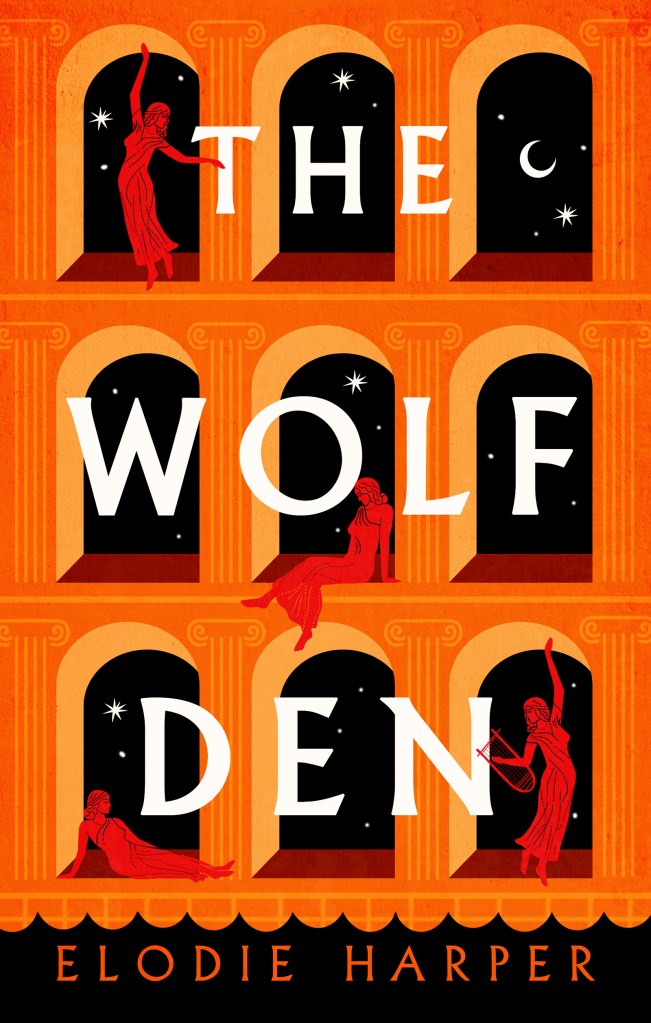
Pages: 451
Published: 13th May 2021
Genre: Historical Fiction
Content warnings: Misogyny, sexual content, sexual harassment

Sold by her mother. Enslaved in Pompeii’s brothel. Determined to survive. Her name is Amara. Welcome to the Wolf Den…
Amara was once a beloved daughter, until her father’s death plunged her family into penury. Now she is a slave in Pompeii’s infamous brothel, owned by a man she despises. Sharp, clever and resourceful, Amara is forced to hide her talents. For as a she-wolf, her only value lies in the desire she can stir in others.
But Amara’s spirit is far from broken.
By day, she walks the streets with her fellow she-wolves, finding comfort in the laughter and dreams they share. For the streets of Pompeii are alive with opportunity. Out here, even the lowest slave can secure a reversal in fortune. Amara has learnt that everything in this city has its price. But how much is her freedom going to cost her?

For all their remarkable innovations, the ancient Roman times were brutal. Disputes often resulted in death, men constantly fought for power and status, and streets frequently witnessed drunken brawls, with fatal consequences. However, those issues largely pale into insignificance compared to what the women had to endure, especially the ones at the lower end of the social spectrum.
This book is a raw and hard-hitting portrayal of female objectification in this era, pulling no punches and sugar-coating absolutely nothing. Through the eyes of a main character who experiences life at rock-bottom and feels the sheer desperation of it for herself and those around her, it tells an awfully powerful story that ripples with tension, just to reflect their fragile and fraught existence.
The brothel where Amara and the other women work is a predictably dire place. It is there that they are routinely dehumanised and condemned to abhorrent treatment at the hands of men who see them as mere commodities to be used at their personal leisure. Even away from their enforced place of work, they are subject to lewd remarks and almost expected to offer all manner of sexual favours.
As a result, these protagonists are fairly close-knit, although each has a different outlook on their situation. All of them would rather be anywhere else, but while Amara would do just about anything to secure her freedom and take her best friend Dido with her, Beronice is more of a dreamer and Victoria hides her vulnerability with a fierce, spirited persona. Either way, they are all compelling characters with a magnificent amount of depth.
Indeed, this is perhaps the book’s greatest strength. It paints the picture very well and really allows you to get to know all the characters, unfurling all their layers with many clever uses of emotive language. The moments where Amara becomes close to Menander and spends time with the clinical, learned figure of Pliny are both nicely understated and in turn effectively demonstrate her powerlessness.
Although the whole story is told Amara’s third person point of view, it has all the essence of a first person narrative in the way that it feels like you consciously experience everything with her. She is maybe slightly hard to get to know at first, but once you get used to all the many characters, her voice really stands out as someone with a strong inner resolve and protective instinct, yet she also has to deal with the devil in order to have a chance of being released.
Amara is definitely someone who you root for, and most of the other women are likeable too, Dido in particular. The only one who was more difficult to connect with was Victoria, as she could be very forthright and savage with her words, but there were also many sides to her and these were her ways of making sure she survived. The unsettling nature of their lives is further amplified by the arrival of Britannica.
Not all of the men in the story are terrible, but the worst of them carry a feeling of entitlement along with being self-important and short tempered. Felix is the most prominent example and to the author’s credit she does add depth to his character too, but the loathing Amara harbours towards him is truly palpable. In fact, his lack of empathy was quite scary.
Even amid all the delicate brush strokes, the arresting and well crafted plot moves along at a relatively solid pace. Split into parts for each month of the year, the chapters are short and eventful, though things noticeably get more intense near the end. It is a dramatic conclusion which contains an upsetting yet unsurprising twist, and creates high stakes heading into the next book in the trilogy.
The setting feels so real. It is immediately clear that the author makes no attempt to romanticise it; instead she makes it gritty and unflattering, with only the baths boasting any sort of tranquility. If anything, the atmosphere is one of deepest foreboding, with the way it emphasises how one wrong step could have serious consequences. The entrapment Amara feels at being owned by Felix is well juxtaposed with the time she spends with Pliny.
What stands out about the writing style is that it is honest and introspective. The dialogue may be coarse and at times unsavoury which takes a bit of time to get used to, but the story is given a massive amount of heart by not holding anything back. If you are looking for an ancient historical novel with lots of luscious descriptions, this is not it. However, that is what makes it so powerful.
Overall, this is a compelling book full of incident and high stakes. In Amara we have a strong yet fallible protagonist who is superbly developed, just like more or less every character across the board. It makes for unsettling reading, but it gets harder to put down the further you progress, and the ending leaves us fascinated for where the story will go next.

Elodie Harper has had a long career as a journalist, acting as a producer on Channel 4 news before becoming a reporter for ITV News Anglia. She combined that with being a short story writer, winning an award for Wild Swimming and then publishing her first novel, The Binding Song, in 2018
However, it is her trilogy set in ancient Pompeii that has propelled her career forward as an author. Published in 2021, The Wolf Den received widespread acclaim, and that has continued with the sequels The House With The Golden Door, and the recently released The Temple Of Fortuna.

An unsettling and hard-hitting novel, but one that strikes so many chords with its powerful depictions and well developed characters.
My rating: ⭐⭐⭐⭐

 Stephen Reads Books