
Pages: 517
Published: 19th May 2020
Genre: Dystopian Fantasy
Content warnings: Injury detail, violence/torture

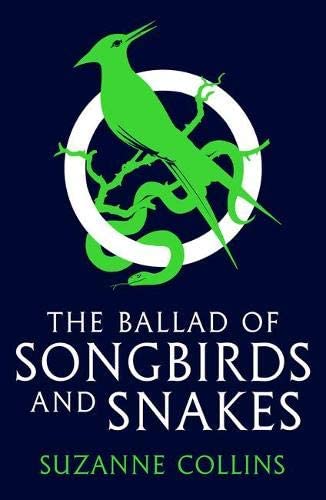
It is the morning of the reaping that will kick off the tenth annual Hunger Games. In the Capitol, eighteen-year-old Coriolanus Snow is preparing for his one shot at glory as a mentor in the Games. The once-mighty house of Snow has fallen on hard times, its fate hanging on the slender chance that Coriolanus will be able to outcharm, outwit, and outmanoeuvre his fellow students to mentor the winning tribute.
The odds are against him. He’s been given the humiliating assignment of mentoring the female tribute from District 12, the lowest of the low. Their fates are now completely intertwined – every choice Coriolanus makes could lead to favour or failure, triumph or ruin. Inside the arena, it will be a fight to the death. Outside the arena, Coriolanus starts to feel for his doomed tribute… and must weigh his need to follow the rules against his desire to survive no matter what it takes.

This is simultaneously a villain origin story and a powerful, thought-provoking novel that sizzles with imagination and tension. It carries us through numerous settings and a plot containing several acts – all of which are full of hard-hitting, emotional moments, while offering the same purposeful writing, ominous atmosphere, and fast-paced action of the original Hunger Games trilogy.
A gripping read for all audiences with its captivating characters and grown-up themes, the initial question marks over the choice of a young President Snow as main character are put somewhat to rest by some magnificent passages of political commentary as we live in the company of his morally questionable perspective, where having a strategy and upholding one’s good reputation is what amounts to success.
As a prequel set many decades before the events of the trilogy, it also gives many insights into the genesis and the embryonic years of the Hunger Games themselves, at a time where the words ‘May the odds be ever in your favour’ had yet to be formulated. It is genuinely interesting to see the world of Panem we are so familiar with before the introduction of more sophisticated arenas, and the whole oppressed population of the districts being forced to watch the action play out on television.
But it is also harrowing. This is a Panem with war still fresh in its memory and revenge very much on its minds, and if you think the tributes are treated as verminous sub-humans under Snow’s rule, then it is several times worse here. They are beaten, malnourished, neglected, and paraded like animals – literally. The scene where the tributes are carted into a zoo enclosure and their injuries treated by veterinarians is about as bleak as it gets, and there is some stiff competition.
Presiding over everything is the slightly unhinged Dr Gaul, who oversees the Games. She has a fearsome ruthless streak that rubs off on Snow just a little, with fatal results, while the moments where they share ideas and interact are intriguing to say the least. This is in contrast to the Games’ founder, the disdainful Dean Highbottom, who never makes any secret of his resentment for Snow.
However, learning about the early years of the Games and the brains behind it is only part of the story here. It is the first Hunger Games with a commentator (Lucky Flickerman’s descendants will eventually master the job), and more importantly the first staging where the tributes are given mentors. In the absence of past winners, the honour goes to a group of largely entitled students of the Capitol, including Coriolanus Snow.
He draws what initially appears to be the short straw by being assigned the girl from District 12, but when he meets Lucy Gray Baird he is taken aback. Lucy Gray is a musician and she is also a fighter, in the less combative sense. The slow burning romance that ensues is beautifully handled and adds huge emotional depth to the story, yet even though you feel their relationship and at times even root for it, you are forever questioning whether it is real or not real.
All of these doubts arise as a result of reading from Snow’s point of view. We know what an evil, despotic ruler he turns out to be, but even with that constantly in the back of our minds there are elements of the young Snow’s character which are compelling and indeed charismatic. This version of Snow is not irredeemably awful – in fact he is capable of some very good, considerate things, but the bad side eventually wins.
It is kind of agonising, as you find yourself wanting him to be a good person. There are times where it feels like he could be, only for his extreme selfishness and the feeling that he is only showing compassion because it will help his future prospects to remind you that it rather a lost cause. As the reader, you are almost there to act as his conscience.
Despite himself, he does develop genuine feelings for Lucy Gray and these are reciprocated. The writing is so good that their connection is quite moving, especially in the moments where she shows a more vulnerable side, such as just before the games begin or the return of Billy Taupe. This relationship is complex, as Snow is attracted to her but loves the idea of power just that little bit more.
Just as gripping is the dynamic between Snow and his fellow student Sejanus Plinth, who is wholly against the Capitol treats the tributes and indeed anyone from the districts, taking a determined stand against the blatant injustice of it all. Unfortunately, nobody else can either understand or relate to his actions, but he is a likeable character for the way he stands up for what is right. He tags along with Snow, believing he has a kindred spirit, but it is clear through Snow’s inner workings that he merely tolerates Sejanus. In the end, their association has major consequences.
The plot of this book is immense, in terms of length as much as anything. It begins at a fast pace and there are the usual helping of chapters with cliffhanger endings that were so common in the original trilogy. The tempo slows down a little during the Games, but once these are over there is still a whole half of the story left to read and the action does not let up.
This is in the fact where it gets more thrilling, as the stakes rise for Snow and he has to decide where his loyalties lie. The final set of chapters are edge of the seat stuff, with life or death scenarios taking the tension to extreme levels and the fate of multiple characters hanging in the balance. In a showstopper of an ending, the author cleverly leaves one key moment open to the reader to make up their own mind.
Music and songs were used powerfully in the initial set of books, and here we see them used to a greater extent as more of a plot device. Lucy Gray and her group of performers from the Covey offer their own unique vibe and it is wonderful how the songs are woven into the narrative, with Maude Ivory a particularly memorable character.
The setting of Panem is fiercely oppressive, but in a different way to what we see in the days of Katniss Everdeen. It is the aftermath of war, where the Capitol is still coming to terms with how to wield its power over the district and even define the true meaning of the Hunger Games, while the technology is nowhere near as advanced. However, the realisation of District 12 is arguably more captivating, with the tranquillity of the lakes a complete contrast to the iron fist of the Peacemakers.
To capture Snow’s calculating mind and also evoke strong feelings from the reader is a tricky task, but the author achieves that by keeping the action ticking over throughout. The writing is rife with urgency and unpredictability, not to mention some very intelligent plot devices such as Snow’s use of the jabberjays and the incredibly fine line he walks between ally and traitor.
Overall, this is a fantastic prequel that delivers maximum impact with its depressingly grim depictions of barbarity, but also takes you on a wild ride of romance and conspiracy. The Games section was a little stop-start but other than that it barely puts a foot wrong, keeping us hooked until the last page and the story on our minds for even longer. On this evidence, songbirds and snakes make for a hugely effective combination.

An excellent book that had me gripped almost all the way through, even more so towards the end.
My rating: ⭐⭐⭐⭐.5

 Stephen Reads Books