
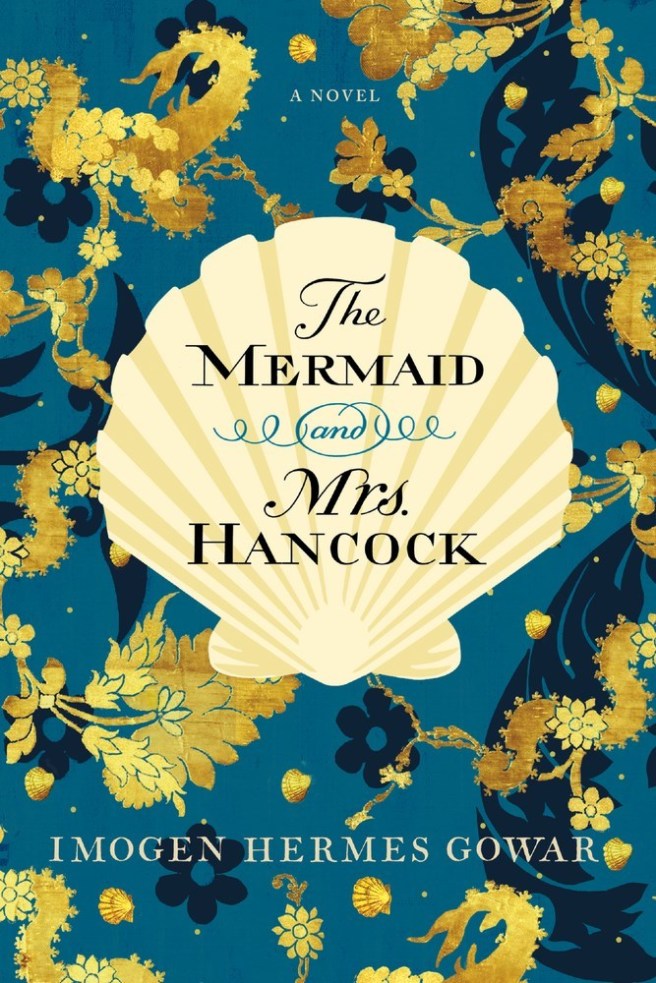
Pages: 484
Published: 25th January 2018
Genre: Historical Fiction
Content warnings: Racism, sexual content

One September evening in 1785, the merchant Jonah Hancock finds one of his captains waiting eagerly on his doorstep. He has sold Jonah’s ship for what appears to be a mermaid.
As gossip spreads through the docks, coffee shops, parlours and brothels, everyone wants to see Mr Hancock’s marvel. Its arrival spins him out of his ordinary existence and through the doors of high society, where he meets Angelica Neal, the most desirable woman he has ever laid eyes on… and a courtesan of great accomplishment. This meeting will steer both their lives onto a dangerous new course.
What will be the cost of their ambitions? And will they be able to escape the legendary destructive power a mermaid is said to possess?

This book is like a bird of paradise; not the most remarkable thing in reality but always showing off to try and get your attention. It is abound with flowery writing and indulgent sequences of colourful scene dressing that showcases the author’s wide vocabulary, yet it all masks a plot that gradually loses its initial potential and develop into something a little underwhelming in comparison.
In many ways it is a story that is all about exploring the contrast between making a modest living and those who find themselves drowning in life’s excesses, and there is a message to be found here. There is an incredibly strong sense of place and there is every effort made towards making the historical context and time period as authentic as possible, which lends it a deep, ever-present atmosphere.
At the beginning there is intrigue. There are two storylines which appear wholly different from each other and you wonder how on earth these paths might cross. The mermaid itself is an interesting concept and creates an air of mystery as the somewhat gormless Mr Hancock gains a reputation and becomes a rich man for exhibiting the bizarre curiosity that has come into his possession. Again, this is well representative of the era, where everyone in British high society craved the unusual or exotic.
The other storyline focuses on wayward socialite Angelica. Her chapters bring a totally different tone and a swifter pace compared the rather pedestrian pace of the action where Mr Hancock is concerned. It is when the plot takes a surprisingly – and somewhat unpalatably – lurid turn that these two characters meet, and from there they strike up an unusual relationship.
As this progresses, they share a unique dynamic although the plot itself loses its momentum. The whole storyline about the mermaid takes some frustrating directions and does not really end up going anywhere, instead just existing without any purpose despite being the thing that brought them together. Perhaps it is meant to be like that, as the author’s way of proving a point that such items were just a sign of decadence, but as a reader you do want a decent payoff and we ultimately do not get one.
After the event where Mr Hancock and Angelica become acquainted, you never really see the book in quite the same way again. It certainly takes time to get your head around the new dynamic, with the character development unusual. The main thing it has going for it is sheer originality, as the writing style and the interesting concepts keeping you invested even when there are doubts of the direction of the plot.
Mr Hancock is a fairly reserved and placid individual; not the brightest but also likeable – which is a nice change compared to other similar male characters in historical novels. The most heartwarming aspect of this is his relationship with his niece Susie, who is very shrewd and headstrong, so that evokes more powerful feelings when things come between them later on as their lives change with his newfound wealth.
His development takes some unexpected turns, but that is nothing compared to Angelica. Her story takes place over three separate acts, and during the first two of these she comes across as ignorant and free-spirited until her wild affair with George comes to an end. From then on into the final third of the book, she undergoes a dramatic personality change which almost makes you wonder if she is the same character, but on the bright side she is better for it.
The side characters are a memorable bunch, full of big personalities. Eliza was another interesting case, as at first she seemed to be the voice of rationality to Angelica’s rashness, but she later shows her true two-faced colours. Along with the haughty Mrs Chappell, she occupies a murky world that is not enjoyable to read about. The same counts for Polly, whose storyline feels tragic but lacked a little bit of depth.
It is of course quite clear that the creature or thing that falls into Mr Hancock’s possession is not a mermaid at all, but still there is something mysterious about it, with the differing effects it has on people adding an extra layer of unpredictability. The setting meanwhile is extremely well realised, so much so that the author all but transports you to a different era with some impressive turns of literary flourish.
Then again, there are moments where the writing style gets a little too elaborate. It is for the most part entertaining to read – overly formal in its descriptions of frivolous activities and you can kind of tell that author had a great time putting all of those words together on the page. There are even some non-standard spellings to match the era, like ‘sofa’ being written as ‘sopha’. It is rather distinctive and is one thing that makes the book stand out.
Overall, there is nothing truly conventional about this book and that is possibly why it attracted the attention of awards committees upon release. The writing style is the aspect that sticks in the mind the most while the setting is highly immersive, although the plot at the centre of it all does not set the world alight. This particular sense of otherness made it hard to form a strong opinion as to whether to love it or hate it, so it likely falls somewhere in the middle.

Having studied archaeology, anthropology, and art history at the University of East Anglia, Imogen Hermes Gowar worked in museums where she would often write stories about some of the artefacts she spent time with every day. That led her back to university and an MA in creative writing, winning the Curtis Brown Prize for her dissertation.
This piece of work would go on to become The Mermaid And Mrs Hancock, which is her debut novel published in 2018, being nominated for that year’s Women’s Prize for Fiction and also winning the Betty Trask Award in 2019. She has since contributed short stories to the ghostly compilations The Haunting Season and The Winter Spirits, and I remember enjoying her work a lot in those two books.

An interesting book that I had been wanting to read for about two years before finally picking it up. The mermaid aspect was a little bit of a damp squib and there were areas of the plot that I did not love, but the writing – showy as it was – kept me entertained.
My rating: ⭐⭐⭐

 Stephen Reads Books