Pages: 328
Published: 28th March 2024
Genre: Science Fiction/Mystery
Content warnings: Violence

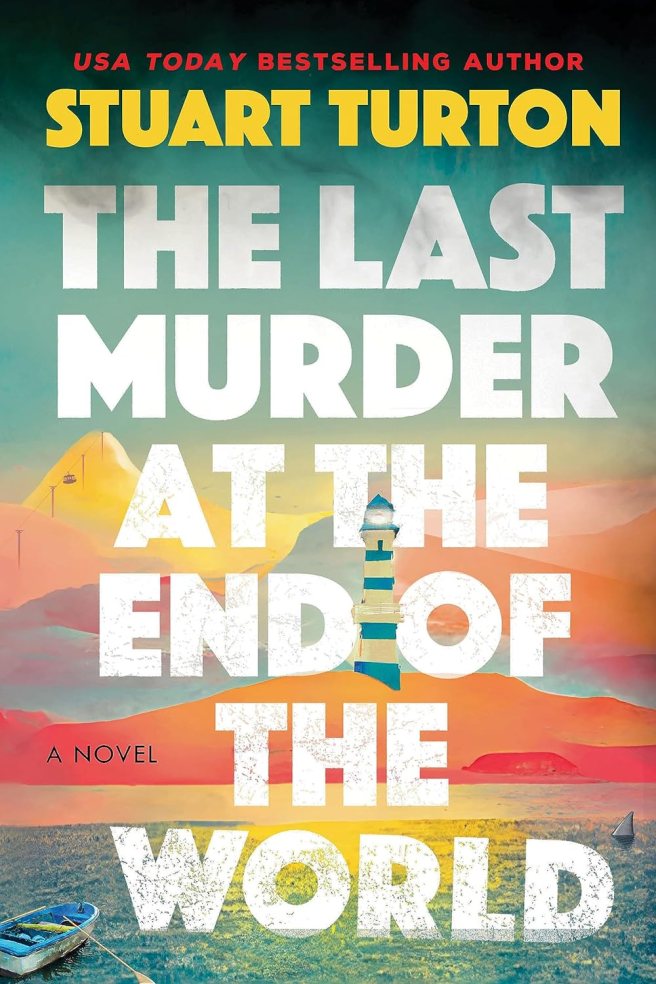
Outside the island, there is nothing: the world was destroyed by a fog that swept the planet, killing anyone it touched. On the island, it is idyllic. One hundred and twenty-two villagers and three scientists, living in peaceful harmony. The villagers are content to fish, farm, and feast, to obey their nightly curfew, to do what they’re told by the scientists.
Until, to the horror of the islanders, one of their beloved scientists is found brutally stabbed to death. And then they learn that the murder has triggered a lowering of the security system around the island, the only thing that was keeping the fog at bay. If the murder isn’t solved within one hundred and seven hours, the fog will smother the island – and everyone on it.
But the security system has also wiped everyone’s memories of exactly what happened the night before, which means that someone on the island is a murderer – and they don’t even know it…

This is about as speculative as speculative fiction can get. With a completely original narrative and a mystery made all the more complex by the presence of time jumps and memory wipes, it creates a futuristic dystopian world like no other. It is abstract and experimental and quite ingenious, but boy is it complicated.
It is impossible not to admire Stuart Turton for his boundary breaking literature. Everything he writes is intricate and intellectually challenging, containing unique concepts with mysteries spanning different genres. This time he pitches his tent in the world of science fiction and comes up with a story that is utterly thought-provoking and provides fertile ground for many a philosophical debate.
The plot is a slow burn, introducing you slowly to the world, its three elders and their community of scientifically grown citizens. The death that takes place about a third of the way through and the murder mystery which follows are preceded by a time jump that effectively casts suspicion on all of the characters, even the ones leading the investigation. If there is one problem here, not enough of them have such an impact that you really care who is responsible. In this case, the how is more interesting than the who.
Perhaps the most remarkable aspect of this book is the narrative, as everything is told very subtly from the perspective of Abi, the artificial intelligence interface that oversees everything on the island and lives in the minds of all its inhabitants. Abi exists in the background, always there but at the same time, not there. We are reminded of her presence when she interacts with the humans and she imparts her wisdom, or when the writing suddenly switches to the first person pronouns.
Everything about Abi is fascinating, and it is clear that she is a very sophisticated way of exploring how artificial intelligence has a growing influence in today’s world. Although she was developed and installed by one of elders, Abi is self-sufficient and capable of independent thoughts and actions, with the means to do anything necessary to carry out her purpose. While she is inoffensive and conversational, she is potentially very dangerous and you can never trust her intentions.
So the premise is irresistibly fascinating, but equally it must be said that this book is an acquired taste. The pace is slow and the plot is not easy to follow at times, with so much to remember about the world and where certain characters fit into events, so please be mindful of the fact your brain will have to do a lot of work. It is certainly not something you can read a lot of in one sitting.
Of the characters, Emory and her daughter Clara are easily the most likeable. Compared to the other villagers, Emory is much more inquisitive and willing to ask searching questions about her existence and surroundings. There is a major character growth with her too, not only in how she takes it upon herself to investigate the murder but also her relationship with Clara which is rather heartwarming.
If it is easy to feel suspicious of Abi because of what she represents, the same can be said about the three elders, who are all clever yet notably short-tempered. Hephaestus is especially prickly and has a violent streak that immediately marks him out as a potential killer. Niema is the wise mastermind of this world who is implied to have hidden motives, whereas Thea is more of a schemer.
The ticking clock of the world sliding closer towards the fog leads to some real suspense towards the end, and when allied with the childlike viewpoints of the villagers it adds to what becomes a surreal atmosphere. It is an unusual setting throughout, where the research labs of the elders are a stark contrast to the basic lives of the villagers on the island.
It seems an odd thing to say, but the writing is engaging yet quite dense at the same time. You really have to concentrate on some of the smaller details, which are hard to find as the high concept does a lot of heavy lifting. There is plenty of flair in there too, as well as some fun continuity with Stuart Turton’s previous books with mentions of The Devil And The Dark Water character Samuel Pipps.
Overall, there is a huge amount to appreciate here, from the ideas and imagination shown in how the world is developed to the sheer uniqueness of it all. To love it though, you really have to get totally on board with everything and take the time to understand all the concepts. Otherwise, you may get lost along the way. What you can say is that it is undeniably a great piece of writing, regardless of how much you connect with it.
I have not read a book like this one before and it was super intriguing. There were a lot of things I liked, although the slow pace and the fact it was hard to follow in places took the rating down a little.
My rating: ⭐⭐⭐

 Stephen Reads Books