
Pages: 378
Published: 22nd June 2023
Genre: Historical Fiction
Content warnings: Misogyny, domestic abuse, fascism

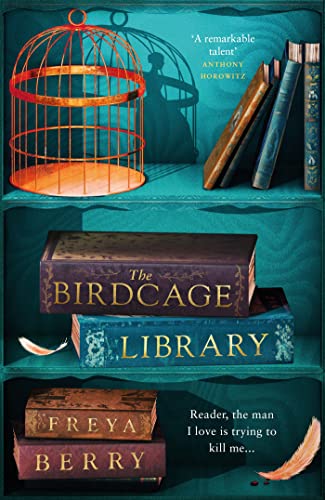
The answers to a puzzle lie hidden within an old book. Open The Birdcage Library and let the treasure hunt begin…
The year is 1882, and the most important thing, unknown reader, is this: The man I love is trying to kill me.
It’s 1932 and adventuress and plant-hunter Emily Blackwood accepts a commission from Heinrich Vogel, a former dealer of exotic animals in Manhattan, living now with his macabre collection in a remote Scottish castle.
Emily is tasked to find a long-lost treasure which Heinrich believes has been hidden within the castle walls. But instead she discovers the pages of a diary, written by Hester Vogel, who died after falling from the Brooklyn Bridge.
Hester’s diary leads Emily to an old book The Birdcage Library and into a treasure hunt of another kind, one that will take her down a dangerous path for clues, and force her to confront her own darkest secret…

This is a story that contains high quality writing and a unique, intriguing concept, but is far too slow and hard to invest in that it fails to set any pulses racing. For the unexpected twists and characters with well hidden backstories, there are also too many sections containing minimal incident and alongside a dual narrative that is well intentioned but poorly executed, it ends up being a laborious read.
Many a theme is touched upon, from grief to parental acceptance to domestic abuse, while there is a healthy helping of high-brow academia that showcases an intelligent attention to detail. A lot of it is extremely clever and we have plenty of suspense to go with it, aided by a secluded setting and some characters who appear more than a little menacing beneath a benign exterior, but reasons to be genuinely enthralled are thin on the ground.
The beginning is actually very promising, as we do not know what Emily has walked into, whether we can trust Henry or if she is walking into a trap. There is an unsettling vibe, but it also feels like we are about to be launched into a race against time with an exciting ride into the history of the item that Henry so desperately wants her to find. It automatically leaves you wanting more, but that feeling subsides as the plot just starts to plod along without any urgency.
Even the introduction of a second narrative does little to liven things up. Hester’s voice certainly has a bit of personality to it; the problem is that there is nothing very interesting going on here for the most part and she simply serves as someone who Emily can relate to in her lonely state. Also, these chapters are presented as diary entries but written in the form of normal prose, which is clearly not very authentic.
The painfully slow burn sadly remains intact until about halfway through, when suddenly we are blindsided by an almighty twist that alters all our perceptions of Emily. It is a moment that shakes you out of your stupor and makes you reengage with the book, and from there it does get slightly more compelling, giving us an opportunity to build a greater emotional connection than before.
It still though does not get as tense as it could be, given the atmosphere. There are some really neat touches, such as the reveal of the diamond and what is hiding underneath Hester’s grave, but that ingredient that piques your curiosity leaves you impatient for answers is missing here. Even the final twist does not have a major impact, partly because it is pretty much the same as the one before. Then the ending itself takes a few leaps of logic.
As we get to learn more about Emily and discover her tragic past, it is quite moving, but perhaps it might have been more effective if it had some relevance to the central plot. Instead, the backstory and her relationship with Daniel is there for not much reason other than to flesh her out. Her sense of loss and the way she finds a kindred spirit in Hester is well conveyed, however.
We only really know Hester through her written monologues, but we can see that she is spirited and not the kind to just be an obedient wife, which her husband Charles clearly does not appreciate. The contrast between Charles and Henry is like chalk and cheese, while the Henry of the present day conspicuously lacks the spark and vivacity of his younger self…
The setting is one of the highlights, boasting an incredibly eerie vibe with the hint there might be something horrific lurking around every corner, especially when you add Hester’s unkempt grave to the mix and the fact Henry will not allow Emily to enter certain parts of the house. There is also a nagging sense that the housekeeper or the two-faced Yves are hiding darkness within.
In many ways it is a shame that the the story itself is underwhelming, because the writing is truly excellent. It is smart and scholarly, with some fabulous turns of phrase and meaningful passages that are worthy of admiration. The problem is that the whole thing just reads very slow, and perhaps it would have been better if it were a little more concise.
Overall, there is a lot going for this book in terms of the concept, the atmosphere, and the author’s undoubted literary skill. Sadly, despite the presence of one or two surprising twists and emotive moments for the two protagonists, it never really catches fire and rarely leaves you determined to read on. It may succeed on objective merit, but not as engaging as such a story ought to be.

A former journalist who studied English at the University of Cambridge, Freya Berry gained success with her debut novel, The Dictator’s Wife, which was published in 2022. The book won the New European Novel of the Year as well as being featured on the BBC’s Between The Covers Book Club.
It was followed a year later by The Birdcage Library.

I really tried my best to enjoy this one, and while I found lots to admire in the writing, I just did not find the plot or the characters very engaging.
My rating: ⭐⭐⭐

 Stephen Reads Books