
Pages: 388
Published: 13th January 2022
Genre: Mystery
Content warnings: Missing person storyline

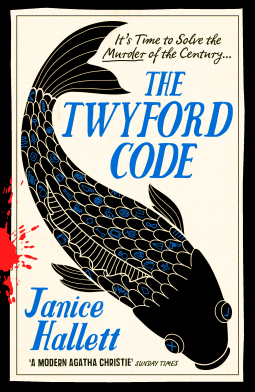
Forty years ago, Steven Smith found a copy of a famous children’s book, its margins full of strange markings and annotations. He took it to his remedial English teacher, Miss Isles, who became convinced it was the key to solving a puzzle. That a message in secret code ran through all Edith Twyford’s novels. Then Miss Isles disappeared on a class field trip, and Steven’s memory won’t allow him to remember what happened.
Now, out of prison after a long stretch, Steven decides to investigate the mystery that has haunted him for decades. Was Miss Isles murdered? Was she deluded? Or was she right about the code? And is it still in use today? Desperate to recover his memories and find out what really happened to Miss Isles,
Steven revisits the people and places of his childhood. But it soon becomes clear that Edith Twyford wasn’t just a writer of forgotten children’s stories. The Twyford Code has great power, and he isn’t the only one trying to solve it…

There are a few extremely rare occasions where you pick up a book and feel entirely blown away by the genius of its concept regardless of its execution, and this is one such case. It is not perfect, yet with a unique style of storytelling that houses a frankly amazing attention to detail, it delivers a compulsive mystery full of fascinating ideas and an altogether memorable reading experience.
Janice Hallett created her own mystery sub-genre with The Appeal, and this one follows a similar formula. A large set of documents to unpick, the devil in the detail, the reader handed an open invitation to solve everything first before the characters do. And although this is much less concise and has more complexity about it, she still provides us with a guaranteed page turner.
Whereas The Appeal required us to pore through an avalanche of emails to disentangle a murder case, here the media format is audio files – no fewer than 200 of them. This is both a positive and a negative, with the bespoke transcription software offering a highly distinctive storytelling device and amplifying Steve’s voice as a multi-dimensional main character.
It also gives ample opportunity for some fun running jokes, such as when Steve’s Cockney accent is wrongly transcribed or contracted words such as ‘must’ve’ are recorded by the software as ‘mustard’. The narrative includes snatched conversations and cryptic clues that are not always what they seem and this creates intrigue, but the downside is that having so many audio files gives us too much to wade through and not everything Steve tells us is necessarily relevant.
The plot is a curious mixture of far-fetched yet also incredibly clever. The idea of the Twyford Code itself is a piece of inspiration and is the highlight of the story, taking Steve on a surprisingly tense factfinding mission and keeping our eyes peeled with all the talk of acrostics hidden in children’s books. Then we have what in many ways is the heartbeat of the story with the disappearance of Miss Iles and Steve being reported missing in the present day, which add an impressive and much-needed emotional weight.
Where it falters is in the resolution, as some of the answers to the mystery are much less exciting than what they promise to be. The Miss Iles thread was rounded off well and left its impact, but the truth about the other characters who appear in the audio files was a disappointment and felt somewhat contrived, which was a bit of a shame when the story appeared to be building so strongly towards a darker, more shadowy conclusion.
None of that diminishes the depth of Steve as a character. He is a bit of a lost soul, scarred by some of the events in his past and looking for a new sense of purpose in his life which comes through revisiting that fateful school trip with Miss Iles. Aided by his rhyming slang and conversational nature, he has an everyman quality about him, sophisticated in spite of his deprived background. All around, his perspective is really interesting to follow.
Miss Iles mostly appears in flashbacks, but she seems like the coolest of teachers; one who loves to encourage a sense of adventure. Then again, some of the most enjoyable passages are the excerpts from Edith Twyford’s books, regardless of what secrets may or may not be hidden within. She is a children’s author in the Enid Blyton mould, full of withering adjectives and low-key snobbery, and Hallett clearly has fun with it.
The idea that these inane stories could be hiding coded messages from the Second World War is an inventive one which sounds absurd, but is not totally implausible. If there is one problem from a reader’s point of view, it is that the clues are ridiculously hard to spot – let alone decipher – even after you learn about the acrostics. When the answers are revealed at the end it is like a lightbulb moment as you realise how cleverly constructed the book is, but you do need an IQ similar to that of Einstein to work it all out.
Overall, this is an informally written story told in a different media format, yet that disguises an immense complexity that runs through it. The characters are well established and it is hard not to be enthralled by the plot even if the ending does not quite hit the mark. There are plenty of laughs too alongside the search for answers, and if you do not figure everything out, well just take comfort in the fact you are not alone.

An outstanding concept and some fascinating ideas and character explorations. The 200 audio files are occasionally a chore to get through, however, and some parts of the resolution were not what I was really hoping for. For the most part though, a good read and so much to be impressed by.
My rating: ⭐⭐⭐.5

 Stephen Reads Books