
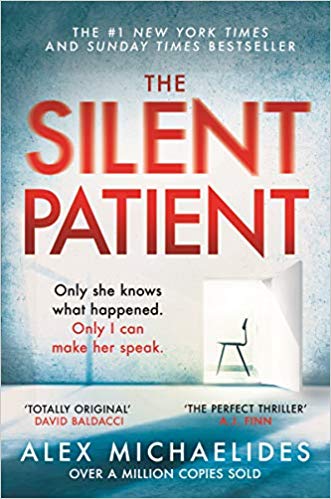
Pages: 339
Published: 5th February 2019
Genre: Psychological Thriller
Content warnings: Violence, mental health storyline

Alicia Berenson lived a seemingly perfect life until one day six years ago.
When she shot her husband in the head five times.
Since then she hasn’t spoken a single word.
It’s time to find out why.

This is a story that carries you into the depths of obsession and there is no release until after it lands the devastating knockout blow. With an ingenious use of narratives and a darkly gripping concept which thrums with an irresistible intensity, it is like a burning fuse as layer upon layer of build-up is carefully applied and then explodes with a stunning twist in the tale, giving us a standout example of how to structure a psychological thriller.
And psychological it most certainly is, in every respect. It is unsettling and a little off-kilter, in terms of both the institutional setting and how the two main characters interact, with an unpredictable feeling of danger lurking throughout. The very extremes of human torment are laid bare with some well realised, sensitive writing that manages to stand alongside the pulsating drama of the plot as it unravels – making it easy to see why this book has received so much praise.
Every aspect is really well developed and the author has that wonderful skill of being able to give us a feel for characters with just a few lines of dialogue, effortlessly fleshing them out. However, what truly elevates the story into unputdownable territory and fuels our fascination, is the way the dual narratives work in tandem. Two unreliable narrators, one in the present and one in the past. One in the first person and the other in the form of diary entries. In many ways they could not be more different, though in reality they tell two versions of the same events.
So many of the apparent facts are established right at the beginning. We learn all about how artist Alicia Berenson killed her husband Gabriel and having not spoken a single word since, was committed to a secure hospital. Theo Faber takes a professional interest in her case and becomes a psychotherapist in the place where she is being kept, making it his mission to get her to speak again.
That in itself is an exciting premise, as we soon discover how much lies within Alicia as a character, such is her ability to communicate in various means beyond simple spoken words. Yet from early on there is a disconcerting sense that Theo has some ulterior motives in gaining access to her, given the manipulative streak that emerges from him as he gains the trust of his bosses – a trait that veers increasingly into recklessness. Even with the subtlest of hints, for so long it is hard to put your finger on exactly what he is aiming to achieve.
Theo is a calculating figure, quite judgmental for a psychotherapist and straight to the point. As such, he is given a very concise voice and through that we learn a lot about him, but only the things he wants us to know. He is unlikable, but somehow as his fragile connection with the mute Alicia starts to grow, it is hard not to root for him. The idea that he might get Alicia to talk is just too tantalising.
Then again, the true thrills come from Alicia’s diary entries. While it must be acknowledged that you have to suspend your disbelief at times – they are written like normal prose and nobody in their right mind would spare the time to write when their life is potentially under immediate threat – they really set the heart racing as you get closer to the moment where she pulls the trigger.
That moment of realisation when the learn the truth of where the diary has been leading us all along is a fantastic reveal, a showstopper of a twist. But there is more to come. The momentum goes on all the way to the last page as the meeting of minds between Alicia and Theo reaches an almighty climax with one final sting in the tail. It is here that we fully appreciate how compelling Alicia is as a character, but also the skill of the storytelling.
The supporting players also have a major role to play in this. Each of them are well developed, as from Theo’s narration we get a proper sense of his colleagues in the secure unit. Indira is the kind and empathetic one; by contrast Cameron is resentful and seems to be the only staff member who can see through his hidden agenda. The way Theo exploits the good-natured Yuri is sad and comes through strongly in the writing, while Diomedes sees the best in everyone and in his role as head of the unit, carries the aura of a Dumbledore-like figure.
Outside that confined setting, the legacy of Alicia’s crime and Theo present-day meddling is felt by those closest to her. Art gallery director Jean-Claire is loyal to a fault and is quite and edgy, outspoken character – but more memorable are the fraught exchanges between Theo and Alicia’s brother Max, who is equal parts rude, dismissive, and uncaring but is interesting to read for that very reason.
The setting of the unit adds to the feeling of menace that perpetuates in this book. The danger and unpredictability posed by the patients is one thing, but also the atmosphere is claustrophobic with scenes taking place in featureless rooms amid secure conditions. It is like the walls are closing in, a perception made more acute by Alicia’s silence, so when she does have the chance to create art it conjures powerful imagery in more ways than one.
But more than anything, the story is written in such a way that just keeps you hooked. The author has an instinctive knack for knowing what works for a thriller as well as an enticing premise, as the pacing is more or less faultless, ramping up the intrigue right off the bat and keeping it simmering steadily until building to a crescendo at the end.
Overall, it is hard to identify many areas where this book puts a foot wrong. The diary entries are a little far-fetched in places but they serve a great purpose and without them, we would not have anything like the extraordinary drama we have over the last few chapters. In terms of structure, plotting, and characters, it hits the jackpot and even better, after all the build up it does not leave us disappointed.

Alex Michaelides achieved almost overnight success after The Silent Patient was released in 2019, as it became an international bestseller – the best selling debut novel of that year in fact. It won the Goodreads Choice Award for the best mystery or thriller and was nominated for several other awards.
Born and raised in Cyprus before securing degrees in English Literature and screenwriting from either side of the Atlantic, Michaelides has followed up with more successful thrillers including The Maidens (2021) and The Fury (2024), but neither have received quite the reaction as The Silent Patient.

You do not always get too many of these, but this is a thriller which does live up to the hype. I was totally compelled by this and the ending was the crowning moment.
My rating: ⭐⭐⭐⭐


Great review!! I read this one recently and really enjoyed it. At first I wasn’t loving it but once everything connected and the twists were revealed I was shocked.
LikeLiked by 2 people
Thanks Misty! I’m glad you loved it too. The twists near the end clinched it for me 👌
LikeLiked by 1 person
Same!!
LikeLiked by 1 person